


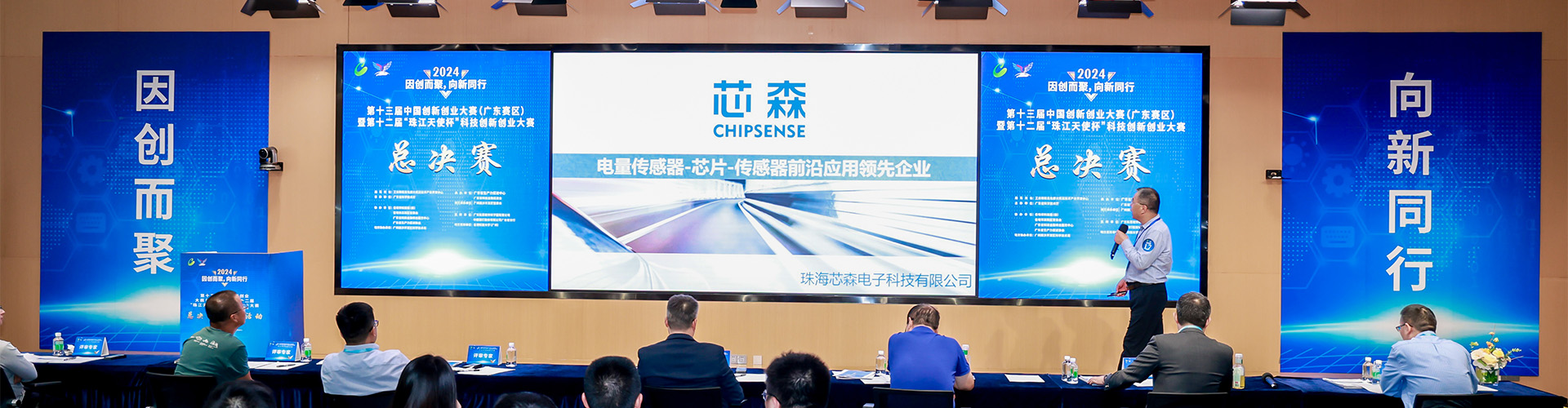
According to data released by the National Energy Administration, as of the end of January 2026, the total number of electric vehicle charging points (guns) in my country reached 20.698 million—a year-on-year increase of 49.6%. Furthermore, new energy vehicles are rapidly entering the era of high-voltage platforms, driving the evolution of charging equipment toward higher power outputs and higher voltage ratings. In recent years, the proportion of public DC charging piles has continued to rise, with 800V platforms, liquid-cooled ultra-fast charging, and high-power centralized charging stations gradually becoming the mainstream configurations for new projects. Against this backdrop, the complexity of electrical safety design for charging piles has increased significantly; notably, residual current detection has evolved from a traditional protective function into a critical component of the overall system safety design. Current sensor suppliers—such as CHIPSENSE—play a crucial role.
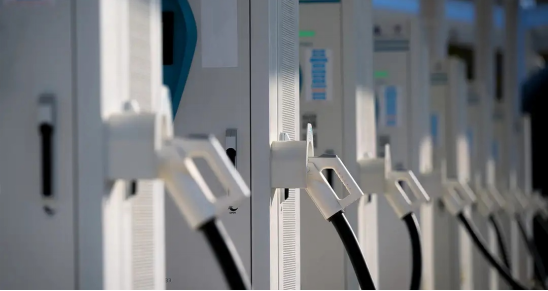
In early AC charging systems, leakage protection requirements could typically be met using Type A residual current devices (RCDs). However, in DC charging systems—which extensively employ rectification, Power Factor Correction (PFC), high-frequency DC/DC conversion, and isolated drive architectures—the system's internal operation inevitably generates DC components and high-frequency common-mode currents. CHIPSENSE current sensors have also detected this issue. This renders traditional detection methods, which rely on power-frequency current transformers, incapable of guaranteeing reliable operation. New revisions to standards such as GB/T 18487.1, IEC61851, and IEC62955 explicitly mandate that whenever a system is liable to generate smooth DC residual currents, it must possess protection capabilities capable of detecting a 6mA DC leakage current; otherwise, the system is prohibited from being put into operation. CHIPSENSE current sensor will meet this requirement.
In terms of circuit architecture, a typical DC charging pile consists of a three-phase rectifier, power quality correction circuitry, a high-voltage DC bus, an isolated DC/DC converter, and a vehicle interface. Due to the presence of numerous switching devices and filtering networks, multiple parasitic paths to ground are established within the system. The CHIPSENSE leakage current sensor has emerged in response to market demand. Common-mode currents generated during switching operations flow through paths such as EMI capacitors, shielding layers, and cable distributed capacitance, thereby constituting residual currents. Unlike traditional power distribution systems, these leakage currents contain not only 50 Hz components but may also include a DC offset and high-frequency components exceeding tens of kilohertz. When a DC offset is present in the detection loop, standard current transformers are prone to entering a state of magnetic saturation, resulting in a loss of sensitivity or even complete failure; this is the primary reason why the new standards mandate the use of B Type residual current detection. CHIPSENSE leakage current sensors are all developed according to standards.
The fundamental principle of a B Type detection device remains rooted in the magnetic balance method: all working conductors are simultaneously routed through a detection magnetic ring. When the vector sum of the currents in each phase is zero, the magnetic fluxes cancel out; however, should a leakage current occur, a residual magnetic flux is generated within the ring, which subsequently produces an output signal via a detection winding. Unlike Type AC or Type A devices, however, B Type detection requires the capability to maintain stable measurement performance across a broad frequency range while simultaneously preventing core saturation in the presence of DC components. Consequently, practical implementations typically necessitate the incorporation of detection architectures—such as magnetic modulation, closed-loop Hall sensors, or fluxgates—combined with analog signal conditioning and digital algorithms to satisfy the relevant standards regarding tripping current thresholds, response times, and anti-interference capabilities. Therefore, CHIPSENSE offers fast-responding leakage current sensors.
In charging systems operating at voltage levels of 800V and above, this issue becomes particularly pronounced. The elevation of high-voltage busbar voltages increases leakage currents resulting from parasitic capacitance to ground, while the high dv/dt transients generated by high-speed SiC devices significantly heighten common-mode interference levels. Furthermore, the use of long charging cables and liquid-cooled power lines further increases distributed parameters, leading to a marked increase in the high-frequency components present in the residual current signal. If the detection circuit lacks sufficient bandwidth or interference immunity, it becomes prone to malfunctions—such as false tripping or failure to trip—or may fail to pass type testing. Consequently, in practical engineering applications, residual current detection is rarely implemented using a simple, single-sensor approach; instead, it is typically achieved through the use of dedicated detection modules paired with zero-sequence current transformers to enhance overall system consistency and reliability. CHIPSENSE recognized this fact, which is why it invested in the R&D of leakage current sensors.
In charging equipment required to comply with standards such as IEC 62955 or relevant GB/T specifications, a common practice involves designing the residual current detection circuit and the detection transformer as separate, discrete units. A dedicated detection module is then utilized to perform a comprehensive assessment of both DC and AC leakage currents. These modules incorporate integrated B Type residual current detection algorithms capable of identifying residual currents across a wide range of wave-forms; upon reaching a preset threshold, they directly output a trip signal. Additionally, these modules support functions such as zero-point calibration during system power-up, self-diagnostic current injection, and trip-time control, thereby ensuring compliance with the operational requirements stipulated by the standards for detecting 6mA DC and 30mA AC residual currents. This is CHIPSENSE Leakage detection module + current transformer module.
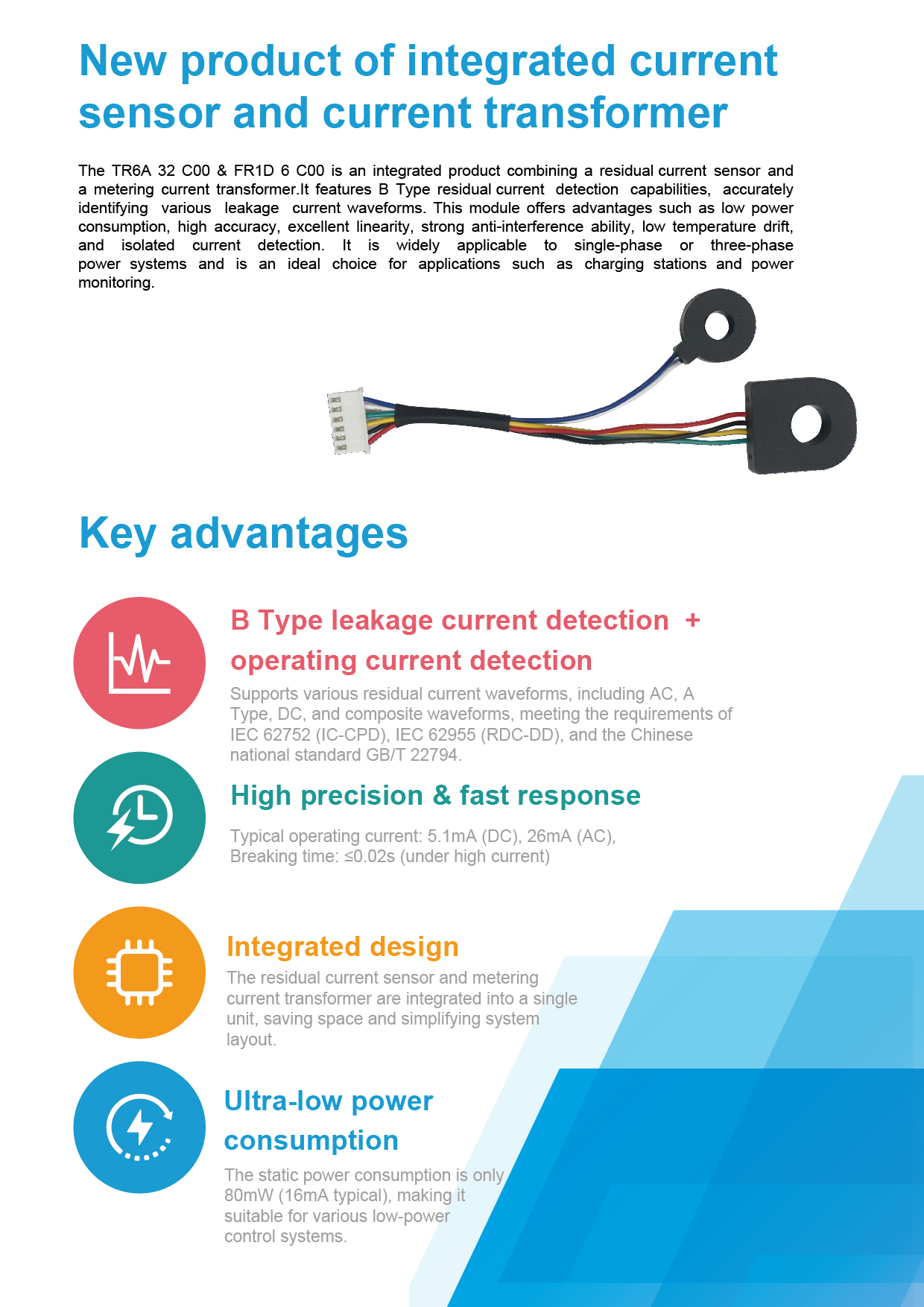
The advantage of this modular approach lies in the fact that detection accuracy and operational characteristics can be calibrated entirely within the module itself; the main control system merely needs to read the actuation signals to execute the protection logic. Furthermore, the physical separation of the instrument transformers from the detection circuitry helps ensure measurement stability in high-voltage environments subject to strong electromagnetic interference. In high-power DC charging stations, portable charging devices, and equipment requiring type-test certification, such specialized residual current detection modules have increasingly become the standard implementation method. CHIPSENSE CSMD1 & TR3A 6 C00 Leakage Detection and Current Transformer Module has received positive feedback from customers following its deployment.
As charging systems evolve toward higher voltages, higher frequencies, and greater power outputs, leakage current detection is no longer merely a simple, supplementary safety feature; rather, it has become a complex technical challenge encompassing magnetic, electromagnetic compatibility (EMC), analog measurement, and safety regulatory design. The ability to reliably implement residual current detection that meets established standards is emerging as one of the most critical—yet most easily overlooked—aspects of the electrical design of charging piles.
CHIPSENSE current sensors remain highly effective in addressing the challenges associated with residual current detection.
CHIPSENSE is a national high-tech enterprise that focuses on the research and development, production, and application of high-end current and voltage sensors, as well as forward research on sensor chips and cutting-edge sensor technologies. CHIPSENSE is committed to providing customers with independently developed sensors, as well as diversified customized products and solutions.
“CHIPSENSE, sensing a better world!
www.chipsense.net