


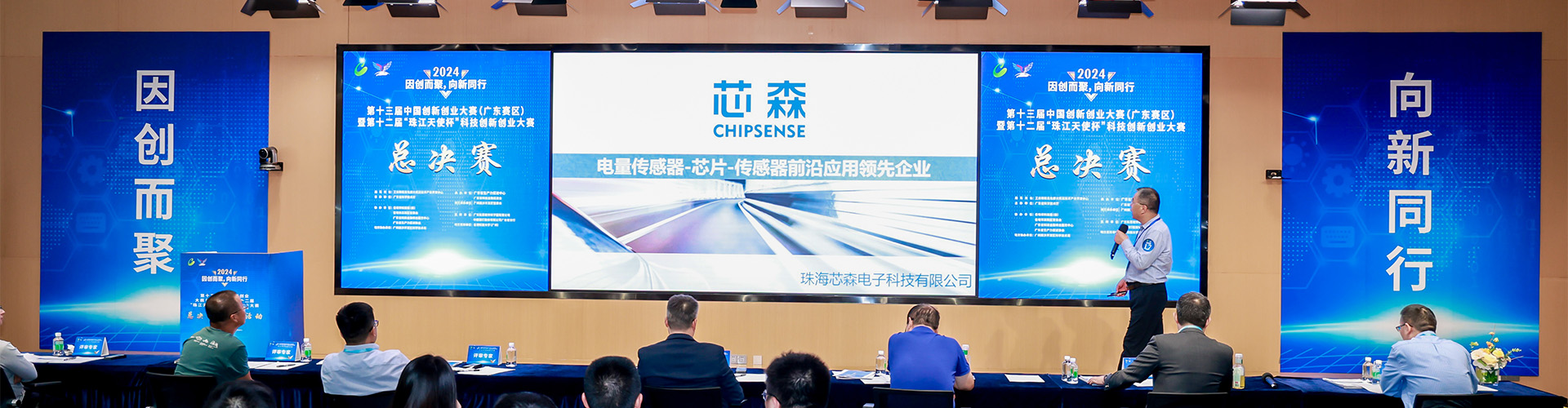
Since 2013, to support the development of the photovoltaic industry and assist companies in expanding into overseas markets, the government has implemented a value-added tax (VAT) refund policy for photovoltaic and other products. With the rapid expansion of the industry, the government has continuously optimized the relevant refund rates in conjunction with macroeconomic tax reforms. Against the backdrop of intense price competition and homogenization in the photovoltaic industry in recent years, on January 9, 2026, the Ministry of Finance and the State Taxation Administration adjusted the export tax refund policy for photovoltaic and other products. From April 1, 2026, the VAT export tax refund for photovoltaic and other products will be completely abolished. In the long run, this adjustment will encourage companies to accelerate their transition away from "policy dependence" and towards a development path centered on technological innovation and cost control. In this context, inverters, as a core component of photovoltaic systems, will see improved conversion efficiency and cost control become crucial for companies to succeed. Current sensors, as the "precise sensing components" of inverters, are important tools for improving power generation efficiency and reducing operation and maintenance costs. This highlights the importance of products from several current sensor manufacturers, including CHIPSENSE.

Impact of Policy Adjustments on the Photovoltaic Industry
Short-term impact: The cancellation of export tax rebates may prompt companies to accelerate exports before April, leading to an increase in module prices (TOPCon 3.0 reaching 0.8 yuan/watt). In this situation, companies should optimize their system integration solutions to reduce BOS (Balance of System) costs and thus maximize profits.
Long-term trend: Promoting technological upgrades: For example, the transition from PERC to TOPCon/N-type technology has improved module efficiency, which in turn places higher demands on the MPPT accuracy of inverters.High-precision current sensors like those from CHIPSENSE have a distinct advantage.
Global competition: Overseas markets have increased demand for local fault diagnosis and remote operation and maintenance capabilities of inverters. Current sensors, as the front-end for data acquisition, have become a core component of intelligent inverters.
How to improve the efficiency of photovoltaic inverters?
The essence of inverter efficiency is to reduce the ineffective energy loss during the conversion process. As photovoltaic technology continues to evolve, Current sensors play a crucial role in this process, inverter efficiency can no longer be improved through single-point optimization; it requires more overall system coordination, mainly focusing on the following five areas:
1. Power device upgrade: From Si to SiC/GaN. This is the most fundamental aspect, because SiC MOSFETs have lower conduction losses, higher switching frequencies, and higher operating temperatures, directly leading to: reduced switching losses, smaller magnetic components, and overall efficiency approaching 99%. However, faster devices require higher demands on the "bandwidth, delay, and anti-interference" of current detection. CHIPSENSE current sensors, offer wide bandwidth, fast response, and excellent interference immunity.
2. Topology optimization: From "functional" to "ultimate loss reduction." Common examples include the evolution from two-level to three-level (NPC/T-type), LLC/CLLC/multi-phase parallel topologies, and the advancement towards grid-forming inverters. These topologies share the characteristics of having more current paths, more complex control, and greater reliance on accurate transient current detection. CHIPSENSE current sensors provide very accurate transient current detection.
3. Control algorithm upgrade: It cannot rely solely on hardware. Control strategies and algorithms such as SVPWM/DPWM/Model Predictive Control, adaptive dead-time control, and light-load efficiency optimization (pulse skipping, phase clipping) have also been transformed and upgraded accordingly. The accuracy of these algorithms depends on precise current measurement data.CHIPSENSE current sensors provide customers with highly accurate current parameters.
4. Thermal management and power density improvement: Higher power density equals smaller thermal margin, so heat must be kept lower.
5. Changes in system-level efficiency assessment methods: Currently, photovoltaic inverters cannot only be evaluated based on peak efficiency, but also on weighted efficiency, light-load efficiency, and dynamic operating condition efficiency. This puts the quality of current detection at the forefront. CHIPSENSE current sensors were developed as a result.
The Role of Current Sensors in Improving Inverter Efficiency
Current sensors are not simply display components, but rather crucial input sources for the control system, often likened to the "eyes" of the system. Their performance directly impacts the actual efficiency of the inverter.
1. The Foundation of Accurate MPPT
Even with improved component efficiency, insufficient MPPT accuracy in the inverter can lead to power generation losses (up to 2%-5%). Current sensors provide real-time feedback on the magnitude and phase of the current. High-precision current data allows control algorithms (such as SVPWM) to more accurately adjust the switching duty cycle, reducing additional power consumption caused by current distortion. CHIPSENSE current sensors are all low-power.
MPPT algorithms need to constantly adjust impedance to match the maximum power point. The faster the response speed and the higher the accuracy of the current sensor, the faster the system can lock onto the maximum power point, especially on cloudy or rainy days with significant fluctuations in sunlight.
2. Enabling Soft Switching Technology
Hard switching (where current and voltage are simultaneously present on the switching device) generates significant switching losses.
Zero-Crossing Detection: Current sensors can capture the "zero-crossing point" of the current. By switching when the current or voltage is zero (ZCS/ZVS technology), switching losses can be reduced to near zero. This is crucial for improving the efficiency of high-frequency inverters.
3. Protection Mechanisms and Reduced "Safety Margins"
Over-current Protection: Extremely fast current detection can instantly identify short circuits or overloads.
Reduced Redundancy: The more accurate the sensor, the less "safety margin" designers need to leave. This means that components with lower internal resistance and more compact specifications can be used, thereby reducing the inherent energy dissipation of the circuit itself.
4. Reduced Operation and Maintenance Costs
Distributed photovoltaic systems have high operation and maintenance costs, and fault diagnosis relies on manual inspection. Integrated current sensors monitor branch currents, and combined with intelligent system algorithms, they can achieve:
Fault Warning: Detecting current anomalies caused by component hot spots and shading.
Remote Diagnosis: Analyzing current data through a cloud platform to reduce the number of on-site inspections (saving 30% in operation and maintenance costs).
Data: In a distributed project, operation and maintenance costs were reduced by 25%, and the return on investment period was shortened by 0.5 years. Saving costs for customers is one of the considerations for CHIPSENSE current sensors.
5. Cost Control
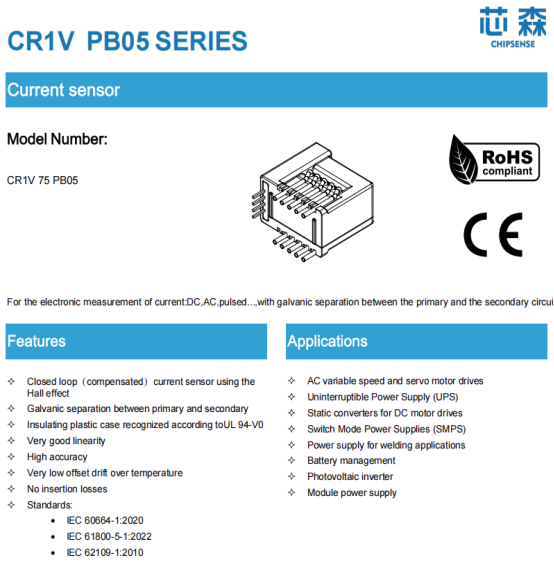
After the cancellation of export tax rebates, the cost pressure on inverters has increased. Inverter solutions can adopt a miniaturized design, and BCP-welded Hall sensors can significantly reduce PCB space occupation and lower material costs. In mass procurement schemes, standardized sensor modules (such as CHIPSENSE 30A/60A current sensor specifications) can reduce procurement costs by 10%-15%. CHIPSENSE current sensors are designed to save customers money. This is an example of CHIPSENSE CR1V P05 current sensor for reference.
Technical Solution Comparison: Applications of Different Sensors in Inverters
| Sensor type | Hall effect (open loop) | Hall Effect (closed-loop) | Current Shunt |
| Accuracy | ±1% | ±0.5% | ±0.3% |
| Response time | 1–3μs | 5–10μs | <1μs |
| Power consumption | Low (<50mW) | Medium (100–200mW) | High (requires heat dissipation) |
| Cost | Medium | High | Low |
| Applicable scenarios | Residential inverters | Industrial and commercial inverters | Medium to large-scale centralized inverters |
| Advantages | Insulation measurement, long lifespan | High precision, anti-interference | Low cost, high reliability |
| Disadvantages | Temperature drift compensation required | Complex circuit design | Requires contact with conductors, insulation is challenging |
Recommendations:
• For residential applications, prioritize open-loop Hall effect sensors (balancing cost and performance).
• For commercial and industrial projects, use closed-loop Hall effect sensors or a combination of shunt resistor and isolation amplifier, considering both accuracy and cost.
CHIPSENSE current sensor is a good choice for customers.
Risks and Challenges
1. Technical Risks:
High-precision sensors have high EMC (electromagnetic compatibility) requirements; improper wiring can easily lead to interference.
Solution: Use differential wiring and shielding design to reduce interference.
2. Supply Chain Risks:
After the cancellation of export tax rebates, the stability of the domestic sensor supply chain becomes crucial.
Recommendation: Choose domestic brands that have passed CQC certification to avoid reliance on imports. CHIPSENSE current sensors are a very professional domestic brand.
3. Standard Changes:
Overseas markets (such as the EU) are increasing their requirements for fault ride-through (FRT) capabilities of inverters, requiring sensors to support fast over-current protection (<10μs).
Future Trends: Intelligence and Integration
1. Digital Sensors:
Integrating ADCs (analog-to-digital converters) and communication interfaces (such as I2C) to directly output digital signals, simplifying inverter design.
2. Multi-parameter Fusion:
Combining data from current, voltage, and temperature sensors to achieve predictive maintenance of inverters.
3. Domestic Substitution:
Driven by government policies, the market share of high-end domestic current sensors (such as ASIC-based products) will further expand. CHIPSENSE current sensors will be an excellent supplier among many current sensor manufacturers.
Conclusion:
From "Tax Rebate Dependence" to "Technology-Driven Growth"
The adjustments to photovoltaic industry policies are forcing companies to accelerate technological upgrades. Current sensors, acting as "efficiency amplifiers" for inverters, play a core role in improving power generation efficiency, reducing operation and maintenance costs, and coping with global competition. Companies should:
1. Optimize sensor selection: Match accuracy and cost according to the inverter power rating.
2. Strengthen data application: Utilize current data to drive intelligent operation and maintenance, and improve project IRR (Internal Rate of Return).
3. Focus on domestic supply chains: Reduce procurement costs and mitigate trade risks.
From above, domestically produced current sensors have become stable and mature, and choosing domestic sensor manufacturers like the professional CHIPSENSE current sensor will be the prevailing trend.
CHIPSENSE is a national high-tech enterprise that focuses on the research and development, production, and application of high-end current and voltage sensors, as well as forward research on sensor chips and cutting-edge sensor technologies. CHIPSENSE is committed to providing customers with independently developed sensors, as well as diversified customized products and solutions.
“CHIPSENSE, sensing a better world!
www.chipsense.net