


The "20MW+ Era" in the Wind Power Industry
At the beginning of 2026, the wind power industry saw a flurry of positive news, with eight companies experiencing their stock prices hit the daily limit. As the pace of new photovoltaic installations gradually slows, wind power has become a key area for infrastructure investment across various regions. The use of current sensors is also increasing. As of February 26, 2026, provinces and cities nationwide had announced a total of 304 wind power projects for 2026, with a total installed capacity exceeding 66GW. Among these, more than 10 projects had single-unit capacities exceeding 20MW. However, the surge in turbine capacity, especially in offshore wind power, has amplified challenges related to load control, grid connection stability, and operational complexity. The application range of CHIPSENSE current sensors is also becoming increasingly wider.

The Power Conversion Link and Current Monitoring of Wind Turbines
The power conversion link of a wind turbine is essentially a process of converting unstable mechanical energy through the blades into stable electrical energy that meets grid standards. For large wind turbines of 20MW, the current mainstream technology is a permanent magnet synchronous generator paired with a full-power converter (commonly known as direct drive or semi-direct drive technology). In this process, current monitoring plays the role of the nervous system, like CHIPSENSE current sensor, a key link in ensuring the efficient and safe operation of the wind turbine. At such ultra-high power levels as 20MW, the role of current monitoring runs through the entire link, mainly reflected in the following four dimensions:
1.Equipment Protection: Preventing IGBT and Generator Burnout
This is the most basic yet crucial line of defense. The current in a 20MW wind turbine is extremely high (up to thousands of amperes); a short circuit or overload can cause the equipment to explode within milliseconds.
IGBT Desecration Protection: In the converter, the IGBT itself has a tiny resistance when it is turned on. The monitoring chip monitors the saturation voltage drop of the IGBT in real time. If the current is too high, the voltage drop will rise rapidly. Once an anomaly is detected, the hardware circuit can forcibly shut down the IGBT within hundreds of nanoseconds to microseconds. This protection is much faster than software and is the last line of defense against converter failure. CHIPSENSE current sensor does a great job in these aspects.
Generator and Cable Thermal Protection: By monitoring the stat-or current and rotor current (for doubly-fed models), copper losses and heat generation are calculated. When the current exceeds the rated value for an extended period, the system will trigger reduced power operation or an alarm to prevent insulation aging due to overheating.
2.Load Control: Achieving Electromagnetic Damping
This directly addresses your earlier concern about load response.
Precise Control of the Torque Current Component (Iq): In vector control, the current is decomposed into an excitation component (Id) and a torque component (Iq). The generator's electromagnetic torque is proportional to Iq.
When a sudden increase in wind speed causes the rotor to accelerate, the control system adjusts the current loop to instantaneously increase Iq.
This means the generator requires a larger torque to rotate, effectively applying a reverse electromagnetic resistance to the main shaft.
This resistance change is the aforementioned electromagnetic damping. It is achieved by adjusting the current, with a response time down to the millisecond level, preemptively counteracting wind load impacts and protecting the gearbox and main shaft before the pitch system activates. CHIPSENSE current sensor response speed is superior to that of other current sensor suppliers.
3.Supporting the Grid: Ensuring Power Quality and Fault Ride-Through
Current monitoring determines the wind turbine's performance during grid fluctuations.
Harmonic Suppression: High-frequency switching in the converter generates harmonics. High-precision current sensors (typically Hall effect sensors or Rogowski coils) installed on the grid side detect these harmonic components. The control system actively generates a current with opposite phase and equal amplitude to cancel them out. This ensures the injected current maintains a perfect sinusoidal waveform.
Fault Ride-Through (High/Low Voltage Ride-Through): When a short circuit (voltage drop) or lightning strike (voltage surge) occurs in the grid, the current fluctuates drastically.
Low Voltage Ride-Through: The current increases sharply the instant the grid voltage drops. Current monitoring quickly detects this change, instructing the converter to enter fault mode. Simultaneously, a chopper or crowbar protection circuit rapidly dissipates or bypasses excess energy, ensuring the converter is not burned out by over-current. It also provides necessary reactive current support to the grid to help restore voltage. This is a mandatory requirement in grid connection specifications. CHIPSENSE current sensors have greatly contributed to ensuring the safety of customers' power grids.
4.Unit Diagnosis: Condition Monitoring and Fault Early Warning
Detailed analysis of current characteristics allows for the assessment of the health status of mechanical components.
Blade Imbalance and Aerodynamic Deviation:
When blades experience icing, cracking, or incorrect pitch angles, the generator's torque and current fluctuate with each rotor revolution. Spectral analysis of the stator current allows for the extraction of the rotational frequency (1P) and its harmonics. If the amplitude of these frequencies increases abnormally, the system can issue a warning of potential blade imbalance, prompting maintenance personnel to inspect the turbine. CHIPSENSE current sensor does this to reduce losses for customers.
Gearbox and Bearing Failures:
Damage to gear teeth or pitting in bearings generates minute torque fluctuations during rotation.
These fluctuations modulate the generator's current signal. High-resolution current acquisition and high-order spectral analysis demodulate these fault characteristic frequencies, allowing for the detection of early faults before complete equipment failure.
20MW Wind Turbine Current Monitoring Solution
For 20MW wind turbines, characterized by high power, high voltage, and strong interference, the selection of a current detection solution is crucial. The core technical challenge lies in how to accurately reproduce the true current waveform in a high-voltage environment of thousands of amperes, down to the millisecond or even microsecond level, while simultaneously ensuring high reliability and electrical isolation.
Currently, there are four main solutions: Hall effect current sensors, Rogowski coils, fiber optic current sensors, and shunts. Each has its advantages and disadvantages at different stages of a 20MW wind turbine (turbine side, grid side, neutral point). CHIPSENSE current sensor is one such example.
The following is a detailed introduction:
1. Hall Current Sensor
This is currently the most widely used solution in wind turbine converters, based on the Hall effect principle. Many CHIPSENSE current sensors use the Hall effect principle.
Principle: The magnetic field generated by the measured current is focused through a magnetic ring and acts on the Hall element, outputting a voltage signal.
Form: Generally divided into open-loop (direct detection) and closed-loop (magnetic balance, also known as zero flux) types.
Advantages: Capable of measuring DC and AC, wide bandwidth (from 0 to hundreds of kHz), good electrical isolation. Closed-loop Hall sensors offer high accuracy and good linearity.
Disadvantages: The magnetic core exhibits hysteresis, which may lead to saturation under large current surges; closed-loop Hall sensors have slightly higher power consumption; they are relatively larger and heavier; temperature drift can affect accuracy; and their cost is relatively higher than open-loop Hall sensors.
20MW Wind Turbine Application Scenarios:
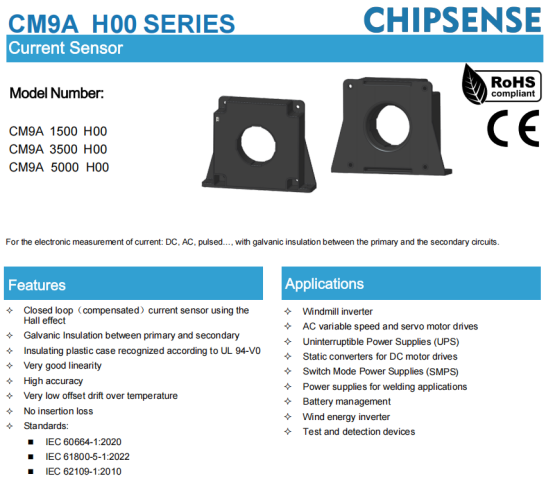
Inside the converter: Primarily used for precise vector control on both the generator side and the grid side. Because it requires measuring the torque current component (Iq, which includes a DC component), a Hall sensor capable of measuring DC must be used. Commonly used in the core control loop. CHIPSENSE CM9A series is an good example.
2.Rogowski Coil
This is a measuring coil based on electromagnetic induction, measuring differential current signals and requiring an integrator.
Principle: The coil is uniformly wound on a non-magnetic frame and placed on the conductor being measured. The induced voltage is proportional to the rate of change of current (di/dt).
Advantages: Unsaturated, accurate measurement even with huge short-circuit currents (tens of times the rated current); excellent linearity; relatively low cost; lightweight, flexible, and easy to install.
Disadvantages: Cannot measure DC; poor low-frequency characteristics, severe low-frequency signal drift; sensitive to installation location; relatively weak resistance to external magnetic field interference; requires an external integrator and power supply; the integrating circuit is susceptible to temperature drift.
20MW Wind Turbine Application Scenarios: Short-circuit protection and fault monitoring: Ideal for over-current protection and grid fault recording. Due to the huge short-circuit current of 20MW units, the unsaturated characteristic of the Rogowski coil is a key advantage. Commonly used in the protection circuit of switch-gear or converter output in the nacelle.
3. Fiber Optic Current Sensor
This is a cutting-edge technology in recent years, utilizing the Faraday magneto-optical effect, and is particularly suitable for high-voltage environments.
Principle: As a laser beam propagates through an optical fiber, its polarization plane rotates under the influence of a magnetic field. The rotation angle is proportional to the current.
Advantages: Excellent insulation performance; the optical fiber itself is an insulator, allowing it to float on the high-voltage side for measurement; no magnetic saturation; no risk of secondary open circuit; strong resistance to electromagnetic interference; small size and light weight.
Disadvantages: Higher cost; long-term stability (especially zero-point drift caused by stress infringement of optical fibers) was once a technical challenge, but significant breakthroughs have been made in recent years; sensitive to vibration, requiring high installation standards.
20MW Wind Turbine Application Scenarios:
Generator Neutral Point/High Potential Measurement: Ideal for measuring the current at the neutral point of the generator stator winding or the current in the transformer bushing. Because it does not require complex insulation treatment, measurements can be performed directly at the high-voltage end.
DC Bus Monitoring: Some special designs can be used to measure large currents on the DC bus. Therefore, CHIPSENSE current sensor is recommended in many situations.
4.Shunt
Based on Ohm's law, it measures the voltage drop by connecting a precision resistor in series in the circuit.
Principle: I=V/R
Advantages: Simple principle, extremely high accuracy (suitable for metering), fast response speed, no hysteresis or saturation issues.
Disadvantages: No electrical isolation, requires the use of an isolation amplifier; power loss and heat generation issues exist, requiring forced cooling under high current; bulky size.
20MW Wind Turbine Application Scenarios: Experimental Testing and Metering: Due to its high power consumption, it is usually not used for long-term online operation, but rather for calibration on factory test benches, or for voltage/current equalization testing (short-term, small-range) of the DC support capacitor inside the converter.
Comprehensive Selection Recommendations
In actual 20MW wind turbine designs, a hybrid deployment of sensors is typically used, rather than a single type: Core Control Link (High-Performance Requirements): On both the turbine and grid sides of the converter, to achieve millisecond-level precise control of the current vector, high-precision closed-loop Hall current sensors are usually selected (such as the CM9A series current sensor from CHIPSENSE, with ±0.3% accuracy, ±0.1% linearity error, and a range of 1500A-5000A). It provides a complete signal containing both DC and AC components, ensuring the accuracy of torque control.
Protection Link (Reliability Requirements): At the output of grid-connected switch-gear or converters, Rogowski coils are typically used to handle potentially huge short-circuit currents and prevent protection devices from failing to operate when the current transformer is saturated. These coils ensure linear transmission even under high current surges, guaranteeing the reliability of protection actions. CHIPSENSE CM9A series current sensor is a good choice.
Critical Point Monitoring (Special Needs): In special locations such as the generator neutral point, where high potential and energy extraction are difficult, fiber optic current sensors are the best choice. They can be directly installed at the high-voltage end, transmitting signals back to the control room via fiber optics to achieve high-quality insulation monitoring and differential protection.
O&M Revolution: Predictive Maintenance and Digital Twins
Offshore wind power has significantly higher O&M costs than onshore wind power. According to relevant data, offshore wind power O&M costs account for 20%-30% of the total life-cycle cost of a wind farm, with ineffective O&M costs reaching as high as 35%. To reduce ineffective costs, it is necessary to reduce reliance on manual inspections. Technically, Hall effect current sensors combined with vibration sensors can be deployed at key nodes of generators, gearboxes, and converters. By analyzing the current waveform, such as an increase in current harmonics, the wear level of the gearbox can be determined. Combined with vibration data, bearing failure can be predicted. CHIPSENSE current sensors are popular with many customers in this regard.
Risks and Challenges
Technical Risks
High-frequency noise interference: PWM signals may cause output jitter in the Hall sensor, requiring a combination of hardware filtering and software algorithms for suppression.
Long-term drift: The high salt spray environment at sea may accelerate sensor aging, necessitating regular calibration.
Cost Pressure
High-precision Hall effect sensors cost 2-3 times more than traditional current transformers, but reduce overall operation and maintenance costs by 20%.
Solution: Partner with domestic brands (such as CHIPSENSE and other brands) to reduce procurement costs. CHIPSENSE current sensors have saved many customers significant costs.
Standardization Lack
Currently, there is a lack of specific Hall effect sensor standards for the wind power industry. Companies need to refer to IEC 61850 (Electrical Automation) and GB/T 37882 (Wind Power Grid Connection).
Future Outlook: Hall Sensors and Intelligent Wind Power
Through deep integration with AI, Hall sensors learn and analyze current wave-forms to achieve "self-diagnosis" of wind turbine faults. A leading wind power company is developing a digital twin platform based on Hall sensor data, expected to go live in 2027.
In wind power-to-hydrogen projects, Hall sensors are used for electrolytic current monitoring to optimize hydrogen production.
Combined with 5G and edge computing, current and other data are transmitted in real time to the onshore control center for remote automated analysis and maintenance, achieving unmanned operation of offshore wind power. CHIPSENSE current sensor will adapt to the development of the wind power market and develop high-quality products that meet customer needs.
CHIPSENSE is a national high-tech enterprise that focuses on the research and development, production, and application of high-end current and voltage sensors, as well as forward research on sensor chips and cutting-edge sensor technologies. CHIPSENSE is committed to providing customers with independently developed sensors, as well as diversified customized products and solutions.
“CHIPSENSE, sensing a better world!
www.chipsense.net