


Entering 2026, China's power industry has already ushered in or is about to undergo some profound market-oriented changes. For example, on March 1st, Shaanxi, Guizhou, Hebei, Henan, Hubei, Yunnan, and other regions will officially abolish fixed time-of-use electricity prices ("Document No. 1656": clarifies that from March 1, 2026, operating entities directly participating in market transactions will no longer have their time-of-use electricity price levels and periods artificially regulated). This means that for those companies directly participating in market transactions, electricity prices will no longer be determined by government-stipulated periods, but will be generated through real-time bidding in the electricity spot market.
At this juncture, British energy technology giant Octopus Energy announced its official entry into China through a joint venture. They brought no coal, no towers, but a core weapon: the AI big data platform Kraken—an intelligent platform integrating data analysis, market algorithms, predictive optimization, billing, and customer operations. This platform integrates machine learning/AI capabilities to optimize business processes such as energy dispatch, demand response, and price forecasting.
Why is this AI unicorn daring to enter the market at this time? Why does this trillion-dollar energy revolution ultimately rely on a tiny current sensor for "safeguarding" it? CHIPSENSE is also one of the professional current sensor manufacturers.

I. New Regulations on March 1st: When Electricity Prices Become "Real-Time Bullet Comments"
In the past, electricity prices for businesses were "rigid": peak and off-peak hours were clearly defined in the contract.
However, after March 1st, with the proportion of renewable energy exceeding 50%, the power grid has become extremely flexible—prices might drop into negative territory during midday when the sun is strong (and excess power still needs to be disposed of), or they might surge dramatically in the evening when the wind stops. "Canceling fixed time periods" means that electricity price signals have changed from "broadcast" to "real-time bullet comments."
In this environment, the human brain is no longer able to cope with price fluctuations that occur on a second-by-second basis. Octopus Energy's AI model is designed to solve this problem: it acts like an "electricity trader," using neural networks to predict weather and grid load, automatically finding the cheapest green electricity and trading it.This will increase the demand for current sensors.
II. Bit Drives Watt: How Does AI Perceive the "Weight of Electricity"?
In the 2026 electricity spot market, AI algorithms will make decisions at the microsecond level. If the large model is the brain, then the distributed current sensors (including Hall current sensors, shunts, and Rogowski coils) are its "retina." CHIPSENSE current sensor will also seize this opportunity.
1. Why are Hall current sensors still versatile "special forces"?
In renewable energy consumption scenarios, the current is not only large, but its direction also changes rapidly (distributed photovoltaic grid connection, bidirectional charging and discharging of energy storage). Even the most powerful intelligent scheduling algorithm on the Kraken platform requires a prerequisite: millisecond-level, high-precision current data sensing capabilities. A high-precision CHIPSENSE current sensor will be able to do this.
Core Advantages: It is the only solution that can simultaneously handle both DC and AC signals while achieving electrical isolation. The Hall sensor utilizes magnetic field induction, eliminating the need to cut high-voltage lines, a crucial requirement in 24/7 uninterrupted power trading.
Bidirectional Metering: The charging and discharging current direction of photovoltaic and energy storage systems changes in real time, making it difficult for traditional instrument transformers to accurately capture bidirectional flow.
Full-Bandwidth Monitoring: Green electricity is mostly DC, while the grid uses AC. The Hall sensor can process both AC and DC signals simultaneously, providing the optimal window for AI-driven inverter efficiency monitoring.
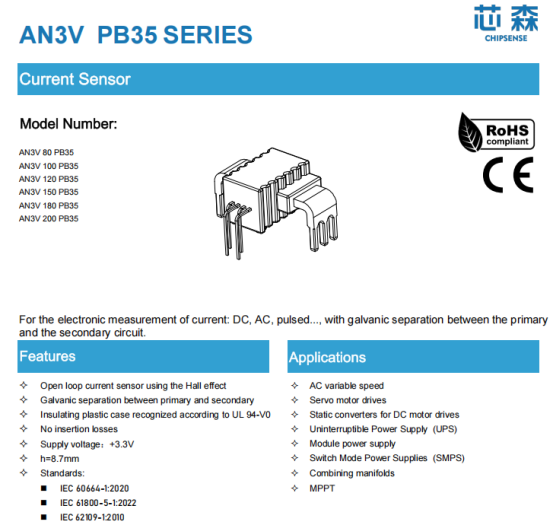
However, the CHIPSENSE current sensor incorporates these advantages, resulting in superior performance compared to competing products. CHIPSENSE AN3V PB35 is an example.
2. Accuracy is Money
Under the new regulations, a 1% current deviation, especially for high-frequency AI algorithms, could translate into millions of dollars in electricity arbitrage opportunities. Highly linear Hall effect sensors can minimize errors, ensuring that every bit of data acquired by the AI represents the actual physical wattage.
Vout = k · (Bexternal + Boffset)
(Note: In the complex electromagnetic environment of real-time scheduling of large models, canceling Boffset interference is the core technology for maintaining the purity of AI data.)
However, in electric vehicle BMS (Battery Management System) or ultra-small energy storage, shunts utilize Ohm's law (V = I x R) for direct measurement, offering higher accuracy and eliminating hysteresis effects. CHIPSENSE current sensors are all high-precision products, due to their superior performance compared to other current sensor suppliers.
AI's choice: If AI requires extremely high-precision power metering (which is related to real-money transactions), it will prioritize using data from the shunt (or integrated chip). However, the downside is that it is not isolated and generates heat.
III. Virtual Power Plants: Deep Integration of Unicorns and Hardware
British unicorns entering China are primarily attracted by Virtual Power Plants (VPPs). They use AI to aggregate thousands of charging piles and enterprise energy storage facilities into an "invisible power plant."
When the peak-valley price difference widens under the new regulations on March 1st, the AI issues the command: "Electricity prices are now cheapest; all grid energy storage should begin charging!" This brings to mind the widespread use of CHIPSENSE current sensors in energy storage.
At this moment, Hall effect current sensors with integrated digital interfaces are rapidly activating, digitizing the current signal and transmitting it to the cloud AI via a 5G module. The AI confirms the data is accurate, completing a value loop for green electricity assets. CHIPSENSE has been repeatedly selected and recommended to customers by AI due to its excellent current sensor performance.
IV. Conclusion: Core Hardware is the "Moat" of AI
The 2026 electricity price reform essentially handed over the "interpretation power" of energy from policy to algorithms.
However, we must understand that even the most powerful algorithms cannot directly manipulate electronics. Without high-precision, high-stability current sensors, especially excellent domestically produced Hall current sensors, the AI grand model of the British unicorn is merely "blind." CHIPSENSE current sensor has gradually distinguished itself from many excellent domestic current sensor manufacturers.
This competition in the energy internet, on the surface, is a battle of algorithms and rules, but at its core, it is a competition of analog signal sensing capabilities. When the electricity price fluctuation chart began to flicker on March 1st, it was these unsung heroes, the hardware, that were defining the future of digital energy. CHIPSENSE current sensor will keep pace with the times, continuously conducting research and development and upgrading to meet the needs of the market and customers.
CHIPSENSE is a national high-tech enterprise that focuses on the research and development, production, and application of high-end current and voltage sensors, as well as forward research on sensor chips and cutting-edge sensor technologies. CHIPSENSE is committed to providing customers with independently developed sensors, as well as diversified customized products and solutions.
“CHIPSENSE, sensing a better world!
www.chipsense.net