



I. Industry Background: The Energy Storage Industry Enters a Period of Explosive Growth
2025 marks a historic development opportunity for the energy storage sector, driven by both technological breakthroughs and policy support:
Policy Level: The National Energy Administration released the "Special Action Plan for the Large-Scale Construction of New Energy Storage (2025-2027)," planning to add over 100 million kilowatts of installed capacity over three years, with direct investment of approximately 250 billion yuan.
Technological Breakthroughs: The industrialization of solid-state batteries is accelerating, with a surge in the release of large-capacity cells (500Ah+), and energy storage system capacity is evolving towards 6MWh and above.
Market Size: In 2025, Chinese energy storage companies are expected to receive 269.05 GWh in overseas orders, 3.3 times the new installed capacity in 2024, demonstrating a leading global position.
Under the major trend of intelligent and safe development of energy storage systems, accurate current detection has become a key link in ensuring the efficient operation of the system.

II. Core Technology Principles of Hall Current Sensors
Based on the Hall effect, most of open-loop current sensing technology achieves non-contact measurement through magnetoelectric conversion:
Working Principle:
The magnetic field generated by the primary current acts on the Hall element.
The Hall element outputs a voltage signal proportional to the magnetic field strength.
Signal conditioning and linearization output are achieved through ASIC technology.
Technical Advantages:
No insertion loss: Does not affect main circuit performance
Electrical isolation: Primary and secondary sides are completely isolated, ensuring system safety
Wide bandwidth response: Supports DC, AC, and pulse current measurement
Compact design: Adapts to the needs of high-density integrated energy storage systems
III. Applications of CHIPSENSE AN1V Series current sensors in Energy Storage Systems
Based on the technical characteristics of CHIPSENSE AN1V PB512 series current sensor, it can play an important role in the following key components of electrochemical energy storage systems (ESS):
1. Current Monitoring in Battery Management System (BMS)
Applications: Real-time monitoring of battery charge and discharge current for SOC (State of Charge) estimation, overcurrent protection, and equalization control.
Applicable Models:
Low-current scenarios (e.g., module-level monitoring): CHIPSENSE AN1V 50/100 PB512 current sensor
High-current scenarios (e.g., battery clusters or system output): CHIPSENSE AN1V 200/250/300 PB512 current sensor
Advantages:
High accuracy (typical accuracy ±1% @25℃)
Wide operating temperature range (-40℃~150℃)
No insertion loss, does not affect system efficiency
2. DC-side Current Monitoring (Battery Pack Output, PCS DC Side)
Applications: Monitors the DC current from the battery pack to the PCS (Power Conversion System) for system protection, energy management, and fault diagnosis.
Applicable Models: CHIPSENSE AN1V 200/250/300 PB512 current sensor (Select according to system current rating)
Advantages:
Supports DC, AC, and pulse current measurement;
Insulation withstand voltage up to 4.8kV, suitable for high-voltage DC systems;
Fast response (tracking time ≤5μs), suitable for transient protection.Most current sensor of CHIPSENSE are like this.
3.PCS AC Output Side Current Monitoring
Applications: Used for output current measurement in grid-connected or off-grid inverters to achieve over-current protection, harmonic analysis, and power control.
Applicable Model: CHIPSENSE AN1V 100/150/200 PB512 current sensors (select according to inverter rated current)
Advantages:
Bandwidth up to 250kHz, capable of capturing high-frequency harmonics
CHIPSENSE current sensors are complies with safety standards such as IEC61800-5-1
Compact size, easy to integrate into power modules
4. Energy Storage System Protection and Fuse Monitoring
Applications: Used for current monitoring of protective components such as DC fuses, contactors, and circuit breakers to achieve rapid fault isolation.CHIPSENSE current sensors have many measurement ranges.
Applicable Models: Select the appropriate range model based on the protection threshold.
Advantages:
Fast response, suitable for short-circuit protection;
Good insulation performance, can be installed in isolation from the main circuit.
5. Energy Management and System Diagnostics
Applications: Used for system-level energy metering, efficiency analysis, and health status assessment. CHIPSENSE current sensors offer many products with different current ratings.
Applicable Models: Select based on the current magnitude at the measurement point.
Advantages:
High accuracy, low temperature drift (gain error temperature drift ≤ ±1.5%);
Good long-term stability, suitable for systems operating for extended periods.
Most CHIPSENSE current sensors have many advantages, making them the best choice for customers.
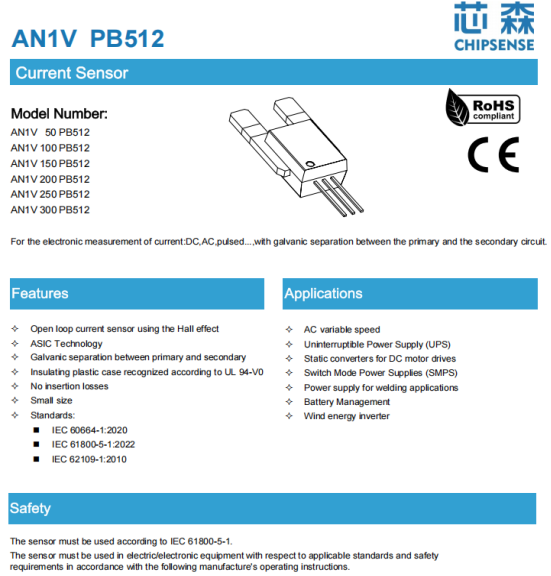
Selection Recommendations:
Application Scenarios Recommended models (based on current range) of CHIPSENSE Key Parameter Focus Areas
BMS Module-Level Monitoring AN1V 50/100 PB512 Accuracy, Zero-point Error, Noise;
Battery Cluster Outlet AN1V 200/250 PB512 Rated Current,
Insulation Withstand Voltage,
Temperature Range;
PCS AC Side AN1V 150/200 PB512 Bandwidth, Response Time,
AC Compatibility;
Protection Circuit AN1V 300 PB512 Response Time, Overload Capacity
CHIPSENSE AN1V PB512 series current sensors, with their high accuracy, wide operating temperature range, fast response, excellent insulation, and multiple current ranges, are ideal for critical components in electrochemical energy storage systems, such as BMS, PCS, protection circuits, and energy management, enhancing system safety, reliability, and operational efficiency. Many customers have given excellent feedback after using CHIPSENSE current sensors.
For further selection support or system integration advice, please contact the manufacturer or technical support team for customized solutions.
CHIPSENSE is a national high-tech enterprise that focuses on the research and development, production, and application of high-end current and voltage sensors, as well as forward research on sensor chips and cutting-edge sensor technologies. CHIPSENSE is committed to providing customers with independently developed sensors, as well as diversified customized products and solutions.
“CHIPSENSE, sensing a better world!
www.chipsense.net