


With the ongoing development of sectors such as AI data centers, new energy storage, high-power charging, and smart microgrids, power systems are rapidly evolving toward greater efficiency, digitalization, and increased reliance on power electronics. These emerging power supply architectures demand higher standards for energy conversion efficiency, system integration, operational reliability, and intelligent control capabilities.
Solid-State Transformers (SSTs)—a new class of power conversion equipment that integrates power electronic conversion with high-frequency isolation technology—are garnering sustained attention across the entire industry chain. They are increasingly being explored for applications in advanced power distribution systems, data center power supply, and the new energy sector.
In response to the evolving landscape of power electronics, CHIPSENSE remains deeply committed to the field of current and voltage sensing. By closely monitoring the measurement requirements of SSTs and related power conversion systems—and leveraging a diverse range of technological approaches and product portfolios—CHIPSENSEcurrent sensor provides the sensor solutions necessary for the precise measurement and stable operation of power electronic equipment.
I. The Development of SST Technology Opens New Avenues for Power Conversion
Traditional line-frequency transformers have long served as a mature technological foundation for power transmission and distribution. However, the rise of DC power supply, the integration of new energy sources, and the emergence of high-power-density equipment have created new demands regarding power conversion methods, power regulation capabilities, and system integration.
Solid-State Transformers (SSTs) achieve voltage transformation through power-electronic conversion stages and high-frequency isolation. Depending on their specific topology, they can facilitate features such as DC output, bidirectional power flow, and power quality regulation—offering a technological alternative to traditional line-frequency transformers for modern power systems.
In the realm of AI data centers, as computing scale and power requirements continue to grow, high-voltage DC power architectures are gaining significant industry attention. The integration of SSTs with DC power systems provides a new pathway for optimizing power delivery chains and enhancing overall system integration, where CHIPSENSE current sensor delivers accurate electrical feedback for system closed loop control.
In the energy storage sector, power-electronic conversion equipment manages the energy transfer between batteries and the grid, requiring systems to handle transitions between charging and discharging, power regulation, and control across various operational states.
In high-power charging and smart microgrid applications, electrical energy must be converted between AC and DC, as well as across different voltage levels, in these contexts, the coordinated control of equipment and the monitoring of operational status are critical.CHIPSENSE current sensor supports fast signal acquisition for these multi voltage level power conversion units.
While these diverse application scenarios differ in terms of system architecture, technical approaches, and engineering requirements, they all share a common trend: the deepening application of power-electronic equipment, alongside an increasing need for the precise sensing and real-time monitoring of electrical parameters.
It should be noted that SST technology is still in a phase of ongoing development and expanding application. Key aspects—such as efficiency, cost, insulation design, thermal management, and long-term operational reliability—require further validation within the context of specific use cases, and CHIPSENSE participates in multiple joint tests to verify sensor performance under these real world constraints.
II. Precise Measurement: A Crucial Foundation for the Stable Operation of Power Electronic Systems
In Solid-State Transformers (SSTs) and related power electronic systems, current and voltage signals are used not only for basic electrical parameter monitoring but also extensively for power calculation, closed-loop control, operational status assessment, and fault protection.
As system power ratings, operating frequencies, and levels of integration continue to rise, the performance requirements for sensors have become increasingly diverse.
Dynamic Response and Measurement Accuracy: During power electronic conversion, current and voltage may fluctuate rapidly in response to changes in switching states or loads. Sensor selection must account for factors such as measurement bandwidth, response time, accuracy, and temperature stability to meet the specific requirements of various control loops.CHIPSENSE current sensor is optimized for fast transient current fluctuation capture in high frequency power conversion.
Insulation Performance and Operational Reliability: When energy is converted across different voltage levels, sensors must comply with insulation coordination requirements relevant to their installation location. This involves careful consideration of electrical clearance, creepage distance, the operating environment, and immunity to interference.All isolation related specifications of CHIPSENSE products are fully verified to satisfy SST system insulation constraints.
System Integration and Interface Compatibility: As power electronic equipment trends toward modularity and compactness, factors such as sensor package dimensions, mounting methods, output formats, and compatibility with downstream control circuitry have become critical considerations in system design.CHIPSENSE provides diversified mechanical packages and signal output options to match compact SST hardware layouts.
Therefore, when selecting sensors for complex power conversion systems like SSTs, it is essential to holistically evaluate the specific topology, measurement location, operating conditions, and control requirements. Only by aligning device performance with the demands of the actual application can a system effectively meet its requirements for measurement accuracy, dynamic response, and operational reliability.CHIPSENSE technical team offers application oriented consulting services to help customers complete sensor type selection.
III. Advancing Product Application Validation and Exploring Measurement Requirements for SST Scenarios
To address the application requirements of Solid-State Transformers (SSTs) and related power electronic systems, CHIPSENSE continues to expand its portfolio of current and voltage sensors, while actively conducting adaptation and validation of these products within specific application scenarios.
Currently, several series of current sensors from CHIPSENSE have entered the application testing phase for SST-related projects. By focusing on the measurement needs of actual systems, these project-based tests allow for the evaluation of how well CHIPSENSE current sensors align with specific operational conditions—thereby accumulating practical experience to support the future expansion of product applications.
Below is the topology diagram showing the application of CHIPSENSE current and voltage sensors within an SST system.
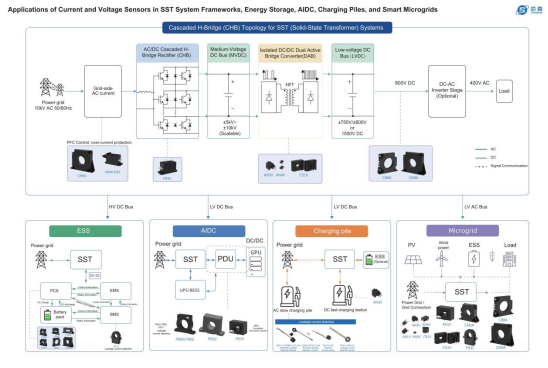
Currently, certain series of current sensors from CHIPSENSE have entered the application testing phase for projects related to Solid-State Transformers (SST). Through these project-based tests, the company is evaluating how wellCHIPSENSE current sensors align with specific operational conditions—a process that provides valuable practical experience for expanding future product applications.
As power electronic equipment trends toward higher power density and modularity, PCB-integrated current sensing solutions offer distinct advantages in certain applications. While such solutions facilitate more compact equipment designs, their implementation requires a comprehensive assessment of factors including measurement range, accuracy, dynamic response, installation requirements, and system interfaces.CHIPSENSE also supplies PCB mount sensor variants for high density power unit integration.
Beyond SST-related applications, CHIPSENSE continues to focus on current and voltage measurement needs in sectors such as energy storage converters, power supply systems for AI data centers, high-power charging infrastructure, and smart microgrids, refining its product portfolio to suit these diverse application scenarios.A broad lineup of CHIPSENSE current sensor covers above mentioned multi industry measurement demands.
For various system designs, CHIPSENSEemphasizes aligning its products with specific technical requirements through rigorous application verification. By ensuring that sensor performance is well-matched to actual operating conditions, the company provides customers with tailored product solutions and technical support to meet their unique application needs.
IV. Upholding Technological Innovation and Continuously Expanding the Boundaries of Intelligent Sensing Applications
Technological R&D and product quality serve as the essential foundation for the sustainable development of any sensor enterprise.
Guided by customer needs, CHIPSENSE consistently advances the R&D of sensing technologies, drives product iteration, and expands application scope. The company also actively engages in industry-academia-research collaborations to foster innovative applications of intelligent sensing technology.CHIPSENSE continuously refines its R&D and quality management systems, tailoring product development to the technical requirements of diverse application scenarios, CHIPSENSE providing customers with current and voltage sensors alongside comprehensive technical support.Every CHIPSENSE current sensor undergoes strict lab calibration before delivery.
From renewable energy generation and energy storage to industrial power electronics, AI data centers, and advanced DC power supply systems, the ongoing expansion of application scenarios places increasingly rigorous demands on the performance, adaptability, and engineering implementation capabilities of sensor products.
CHIPSENSE remains committed to monitoring the evolution of power electronics and related industries. By deepening its technical expertise in current and voltage sensing, CHIPSENSE ensures that its product portfolio evolves in tandem with market demand, delivering sensor solutions that are precisely aligned with the practical needs of its customers.
Conclusion
The development of Solid-State Transformers (SST) offers a new technical trajectory for modern power conversion and supply architectures, further underscoring the critical value of precise electrical measurement within power electronic systems.
Targeting sectors such as energy storage, AI data centers, high-power charging, and intelligent microgrids, CHIPSENSEwill continue to focus on current and voltage sensing technologies, optimize its product portfolio, and drive the deep integration of CHIPSENSE current sensor and intelligent sensing with next generation power electronic systems.CHIPSENSE perceives a better world, sensing makes the world smarter.
CHIPSENSEis a national high-tech enterprise that focuses on the research and development, production, and application of high-end current and voltage sensors, as well as forward research on sensor chips and cutting-edge sensor technologies. CHIPSENSEis committed to providing customers with independently developed sensors, as well as diversified customized products and solutions.
“CHIPSENSE, sensing a better world!”
www.chipsense.net