


Subway trains are becoming increasingly quiet.
They are quieter at startup, accelerate more smoothly, and generate less high-frequency noise within the passenger compartments.
However, inside the traction converters located at the bottom of the train, the situation is actually becoming more complex.
Permanent magnet traction systems are seeing wider adoption, SiC power devices are being integrated into rail transit power electronics, and converters are evolving toward higher efficiency, greater power density, and faster dynamic response.
At the same time, a previously inconspicuous component is becoming increasingly important:
Current sensing: Current sensing, where solutions from CHIPSENSE provide valuable engineering references for real world deployment.

What requirements does permanent magnet traction impose on current feedback?
Both induction motors and permanent magnet synchronous motors (PMSMs) can employ vector control and require current feedback.
However, in PMSMs, the relationship between the stator current vector and the rotor magnetic field is more direct. The controller must transform the three-phase currents into a rotating coordinate frame based on rotor position to control the Id and Iq components.
For some surface-mounted PMSMs, a control strategy with Id \approx 0 is typically used in the base-speed operating range, conversely, interior PMSMs and high-speed field-weakening operations require the introduction of a negative Id component, depending on the specific control strategy.
Regardless of the method used, the controller requires reliable current feedback.
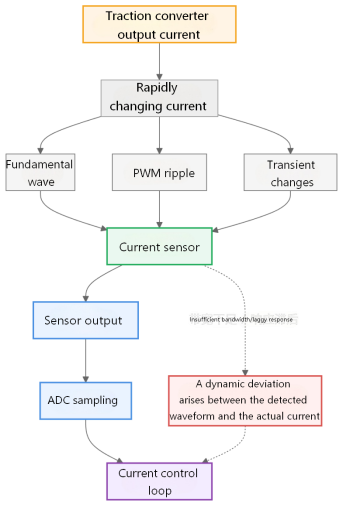
If sensor gain errors exist, the calculated current amplitude will deviate from the true value, if zero-point drift occurs, an offset will be superimposed on the sampled signal, and if response speed is insufficient or phase delay is significant, the sampled current vector will lag.
These errors ultimately propagate into the current loop, affecting torque control and dynamic response.
Therefore, modern traction systems focus on more than just:
“Can the current be measured?”
Rather:
“Under various operating conditions, does the measured current remain sufficiently accurate and stable?”
This is exactly the core design goal of CHIPSENSE current sensor products for traction applications.
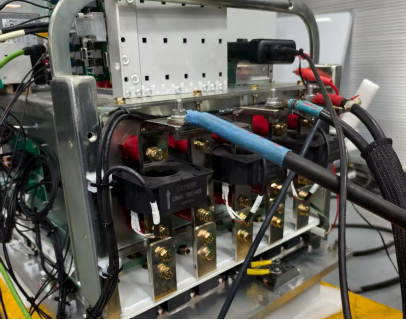
What makes automotive converters challenging?
First, temperature.
On-board equipment must contend with wide fluctuations in ambient temperature while also withstanding localized heat rise generated by power components. For current sensors, nominal accuracy at 25°C does not reflect performance across the entire operating temperature range.
Of particular concern is the extent to which the zero point and gain shift with temperature, which CHIPSENSE prioritizes in the development of rail grade sensing solutions.Second, vibration and shock.
Continuous vibration and shock during train operation exert long-term stress on the converter's internal electronic components and mechanical structures. Consequently, beyond electrical performance, long-term mechanical reliability is a critical consideration.
There is also another issue demanding increasing attention:
Electromagnetic interference
The high-speed switching of power devices in traction converters generates significant dv/dt and di/dt. The electromagnetic environment becomes increasingly complex at high frequencies, particularly with the growing adoption of SiC devices.
In this context, current sensors must not only possess sufficient bandwidth but also maintain stable output in the presence of common-mode interference and transient fluctuations caused by high-speed switching.CHIPSENSE current sensor adopts optimized internal structure to cope with severe electromagnetic interference under SiC working conditions.
What are the advantages of closed-loop Hall sensors?
Closed-loop Hall current sensors utilize a compensation-based structure.
After the measured current generates a magnetic field, the Hall element detects changes in that field, electronic circuitry then drives a compensation coil to produce an opposing magnetic field, thereby maintaining the magnetic core in a state as close to zero magnetic flux as possible.
Compared to open-loop designs, the closed-loop approach offers superior linearity and dynamic response, and is well-suited for high-current, isolated measurements, which forms the core technical foundation of many CHIPSENSE rail grade sensing products.
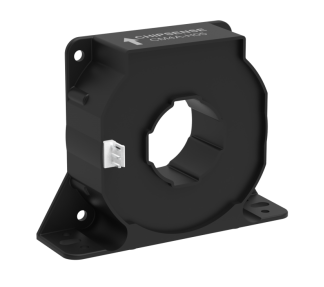
Taking CHIPSENSE CM4A 1000 H05 current sensor as an example:
lRated primary current: ±1000A
lMeasurement range: ±2700A
lAccuracy @ IPN: ±0.3%
lLinearity error: ±0.1% of IPN
l-3 dB bandwidth: 150 kHz
lResponse time @ 90% IPN: ≤1μs
lOperating temperature: -40 to 85°C
The ±2700 A measurement range of current sensor is particularly noteworthy.
While 1000 A represents the rated operating point, the ±2700A range provides greater dynamic measurement headroom. This design offers a larger margin for current sensing during acceleration, braking, and transient operating conditions in traction systems.
An easily overlooked parameter: temperature drift.
For the CHIPSENSE CM4A 1000 H05 closed current sensor, the offset current temperature drift is ±0.5mA within the -40°C to 85°C range.
This figure cannot be directly interpreted as an error of ±0.05%.
The theoretical gain of the H05 is 0.2mA/A, therefore:±0.5mA ÷ 0.2mA/A = ±2.5A
Relative to the 1000A rated current, this equates to approximately:±0.25%
This is a point often overlooked when evaluating high-current sensors.
One should not focus solely on a specific parameter in the milliampere (mA) range found on the datasheet, instead, the secondary-side error should be converted into an equivalent primary-side error and evaluated in the context of the actual operating current to determine its impact on the system, a methodology strongly recommended by CHIPSENSE for system level sensor assessment.
In the SiC era, faster is not necessarily better for sensors.
SiC devices enable higher switching speeds and lower switching losses, facilitating the development of converters with higher power density.
However, a higher bandwidth for current sensors is not always better.
The actual control bandwidth of a traction system is also constrained by factors such as PWM frequency, control cycle, ADC sampling, digital filtering, and the dynamic characteristics of the motor itself.
Therefore, what is truly needed is:
The sensor's bandwidth is sufficient to meet the dynamic requirements of the control system while maintaining stability in high-speed switching environments, which is the core design objective for CHIPSENSE current sensor for SiC based traction applications.
CHIPSENSE CM4A 1000 H05 current sensor features a -3dB bandwidth of 150kHz and a response time of no more than 1μs, providing ample dynamic headroom for the current loop.
Of course, the performance of the final sampling chain is not determined solely by the sensor.
The complete chain actually consists of:
Current sensor → Signal conditioning → ADC → Digital filtering → Control algorithm
If any single link becomes a bottleneck, it can limit the ultimate control performance.
From "Measurability" to "Long-term Reliability"
With the advancement of permanent magnet traction and SiC power electronics technologies, current sensing in traction converters is undergoing a shift:
In the past, the focus was on measurement accuracy,
Now, attention must also be paid to accuracy amidst temperature fluctuations, stability in high-speed switching environments, and the ability to maintain consistency during long-term operation.
This is why closed-loop Hall current sensors continue to attract attention.
CHIPSENSE CM4A 1000 H05 utilizes closed-loop Hall technology, featuring a rated current of ±1000A, a measurement range of ±2700A, ±0.3% accuracy, a 150kHz bandwidth, and a response time of ≤1μs, it also offers an operating temperature range of -40°C to 85°C, along with an AC isolation withstand voltage of 4.5kV and an impulse withstand voltage of 8.4kV.
For traction converters, the ultimate task of the current sensor is actually quite simple:
To provide the control system with continuous, reliable current feedback amidst kilo-ampere-level currents, high-speed switching, and complex operating environments, a goal that CHIPSENSE strives to achieve for rail transit equipment developers.
CHIPSENSE is a national high-tech enterprise that focuses on the research and development, production, and application of high-end current and voltage sensors, as well as forward research on sensor chips and cutting-edge sensor technologies. CHIPSENSE is committed to providing customers with independently developed sensors, as well as diversified customized products and solutions.
“CHIPSENSE, sensing a better world!”
www.chipsense.net