


I recently had tea with some friends who work in photovoltaic inverter R&D, and they were all complaining about the same thing: "involution."
Previously, it was about efficiency; now it's about "quality-to-price ratio" (i.e., high performance at a low price). With overall system costs squeezed to the limit, many are focusing on that inconspicuous yet extremely crucial component—the current sensor.
If you're selecting a next-generation photovoltaic inverter, or simply want to understand why your inverter keeps malfunctioning, this article is worth your 3-minute read. Today, we won't discuss obscure formulas; let's talk about the facts. CHIPSENSE current sensor is one of them.
I. Don't Just Focus on Famous Brands, Times Have Changed
Five years ago, when you mentioned current sensors, everyone immediately thought many famous brands. Yes, they were industry benchmarks, the pioneers of closed-loop Hall effect technology.
But it's 2025 now, and the market logic has changed. With the rise of domestic supply chains (such as brands like CHIPSENSE that focus on high-performance current sensor domestic alternatives), and the extreme cost control requirements of photovoltaic inverters, many people are starting to wonder: Do we really need to use such expensive sensors?
Current trending searches tell us that everyone is looking for "affordable alternatives." But note that affordable alternatives don't mean downgraded features. On the contrary, domestic brands like CHIPSENSE may have an advantage over international giants in terms of supply chain and responsiveness to technical support, while maintaining current sensor basic performance. This is crucial in today's "delivery assurance" environment.
II. The Life-or-Death Choice: Hall Effect or Fluxgate?
This is currently a highly debated technical issue with a high search volume.
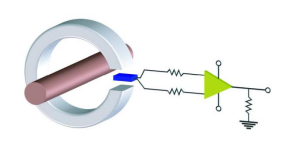
1. Open-loop Hall Effect:
In layman's terms: Inexpensive, durable, and small.
Suitable scenarios: Household micro-inverters, or combiner boxes with less stringent accuracy requirements. CHIPSENSE current sensors are all high-precision.
Drawbacks: High temperature drift. Readings may become erratic in hot or cold weather. If you are building a high-end system that prioritizes extreme MPPT efficiency, use with caution.
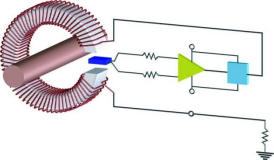
2. Closed-loop Hall Effect Sensor:
In layman's terms:High precision, fast response, the industry's "all-rounder."
Applicable scenarios:The mainstream choice for the vast majority of string inverters. CHIPSENSE has many inverter customers and got many good feedback for customers.
Current situation:Previously very expensive, but now the price has come down due to the entry of domestic chips (such as some solutions based on TMR technology, and the closed-loop series current sensor promoted by CHIPSENSE).
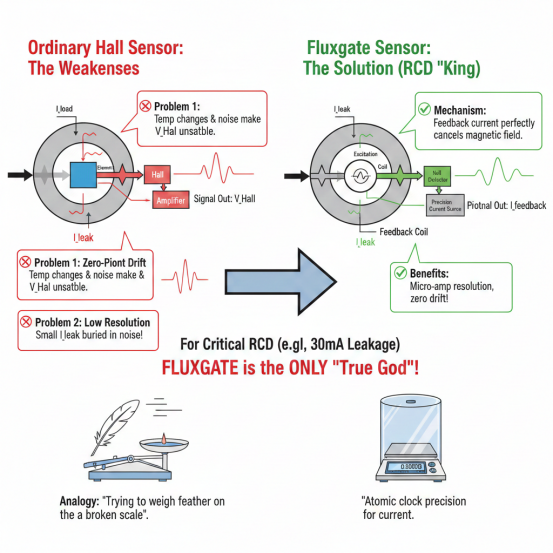
3. Fluxgate:
In layman's terms:High-precision, with virtually zero temperature drift.
Suitable applications:High-end energy storage PCS, high-power centralized inverters, or leakage current detection (RCMU) for safety certification. CHIPSENSE current sensor is suitable for many scenarios and can even be customized.
III. The Real "Invisible Killer": New Challenges Brought by SiC (Silicon Carbide)
This is also a term that has recently seen a surge in Google and Baidu searches.
Current inverters are all moving towards SiC (silicon carbide) power devices. The advantages are higher switching frequencies, smaller size, and higher efficiency. But the disadvantage is: significantly higher interference (extremely high dv/dt).
Many older current sensors simply cannot react to the high-frequency switching of SiC, or their output waveform is directly interfered with into "garbled text." Therefore, the selection of the current sensor must be strictly controlled.
Therefore, the "best" sensors today must possess two key specifications:
1. High Bandwidth: Must be able to keep up with switching frequencies of at least several hundred kHz.
2. Compatibility with Interference Prevention and Interference (CMTI): Must not generate false alarms when high voltage is applied.
If you're still using a slow, ten-year-old sensor with the latest SiC inverter, a system failure is truly only a matter of time. It might want to try CHIPSENSE current sensor.
IV. Avoiding Pitfalls: Don't Ignore These 3 Points When Selecting a Sensor
Integrated Chip vs. Discrete Module: The current trend is towards integrated current sensor chips (such as SOIC-16 packages). For onboard designs below 100A, chip solutions not only save space but also offer higher production line placement efficiency. Labor costs are also a cost! One of CHIPSENSE current sensor's goals is to save costs for its customers.
Supply Chain Security: Don't just look at performance; delivery time is also crucial. Everyone was wary of the chip shortages of the past two years. The current "best" sensor is undoubtedly from a manufacturer that can guarantee a stable supply and offers pin-to-pin alternatives—in this regard, domestic current sensor manufacturers like CHIPSENSE are increasingly gaining an advantage.
Thermal Management: What if the sensor pins overheat at high currents? Pay attention to the internal resistance parameters in the datasheet. A difference of a few tenths of an ohm can translate to several watts of power consumption at high currents, not only wasting electricity but also potentially burning the board. But CHIPSENSE current sensor will avoid these problems.
Conclusion
There is no best, only the most suitable.
Returning to the title, who is the "best"?
If you are producing high-end residential energy storage for export to Europe and America, with leakage protection requirements, fluxgate magnets are your best choice.
If you are making minimalist microinverters, competing on price like on Pinduoduo, then integrated Hall effect chips are your best choice.
If you are making large-scale industrial and commercial units, closed-loop Hall effect modules (whether from international giants or high-performance domestic manufacturers like CHIPSENSE) remain the mainstay. Even CHIPSENSE current sensor is the best choice.
In the second half of the photovoltaic industry, the competition is not about whose PowerPoint presentation is more impressive, but whose Bill of Materials (BOM) is smarter. CHIPSENSE current sensor will continue its efforts to correctly stand out among many suppliers.
CHIPSENSE is a national high-tech enterprise that focuses on the research and development, production, and application of high-end current and voltage sensors, as well as forward research on sensor chips and cutting-edge sensor technologies. CHIPSENSE is committed to providing customers with independently developed sensors, as well as diversified customized products and solutions.
“CHIPSENSE, sensing a better world!
www.chipsense.net