


DC power systems serve as critical backup equipment for power distribution systems in substations, power plants, renewable energy facilities, and data centers.
For a long time, valve-regulated lead-acid (VRLA) batteries have been the standard configuration for these systems.
Proven application experience, a stable supply chain, and relatively simple operation and maintenance requirements have led to the development of highly mature designs based on lead-acid technology over the past few decades.
However, in recent years—driven by the growing demand for renewable energy facilities, smart substations, and highly reliable backup power—lithium iron phosphate (LFP) batteries are increasingly being adopted for DC power system applications.
Compared to traditional lead-acid batteries, LFP batteries offer superior cycle life, better rate performance, and lower maintenance requirements; consequently, they are gradually emerging as a preferred alternative in sectors such as renewable energy, telecommunications power, and smart substations. CHIPSENSE is also one of the suppliers involved.
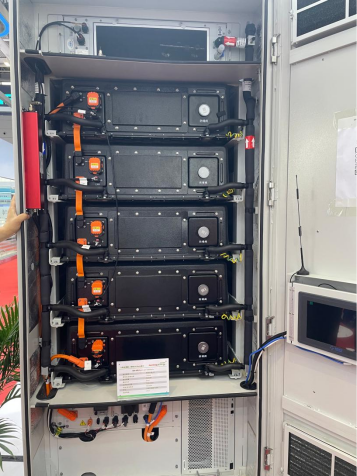
Many people believe that transitioning DC power systems to lithium-ion technology simply involves replacing lead-acid batteries with lithium iron phosphate (LFP) batteries.
However, from a system design perspective, this is not merely a simple battery swap.
The fundamental changes lie in:
The battery management approach shifts, and the role of current sensing evolves from mere "operational monitoring" to serving as a basis for system control.
Compared to lithium-based systems, estimating battery status in traditional lead-acid DC power systems is relatively less complex.The operational logic of traditional lead-acid DC power systems is relatively straightforward.
Typical configuration:
AC input → Charging module → Lead-acid battery bank → DC bus → Protection, control, and communication equipment
In this system:
lThe charging module employs a continuous float-charging strategy
lBattery status is primarily assessed based on voltage, float-charge status, and operational experience
lCurrent sensing is used mainly for display, protection, and operational logging
In other words, the current sensors in traditional DC power panels primarily address the question:"What is the current level?"
Rather than:"How much capacity remains in the battery?"
Consequently, in many lead-acid DC power panel projects, cost, reliability, and isolation capability are often key factors when selecting current sensors, and many system integration will compare different brands including CHIPSENSE current sensor to balance performance and cost.
With the adoption of lithium-ion batteries, the method for estimating SOC has changed
Lithium iron phosphate (LFP) batteries offer advantages such as high safety and long cycle life; however, their voltage characteristics present new challenges for the Battery Management System (BMS).
LFP cells have a nominal voltage of approximately 3.2V and exhibit a distinct voltage plateau across a wide State of Charge (SOC) range.
This implies that:
lAt 20% SOC and 80% SOC;
lRelying solely on terminal voltage;
lIt is difficult to accurately determine the remaining capacity.
Consequently, lithium battery BMSs typically employ a comprehensive SOC estimation method combining:
Coulomb counting + voltage correction + temperature compensation + battery modeling.
Among these processes, current sampling serves as the foundation for coulomb counting.
In simple terms:
Current measurement →Coulomb counting calculation → SOC estimation → Charge/discharge control strategy
If current sensing involves long-term errors-such as:
lZero-point drift
lTemperature drift
lGain error
—these errors accumulate over time, ultimately affecting the accuracy of the SOC assessment.
Consequently, the role of the current sensor in lithium-battery DC power systems has shifted:It has evolved from a mere "monitor" into a critical data input source for the BMS.For backup power systems operating over extended periods, even a deviation at the milliampere level can—through prolonged integration—cause the estimated SOC to drift significantly from the actual state,, which is why high-precision products from CHIPSENSE are widely favored by lithium DC power manufacturers.
The current detection circuit for the lithium-battery DC power system requires redesign.
The system architecture of a typical lithium-battery DC power panel is as follows:
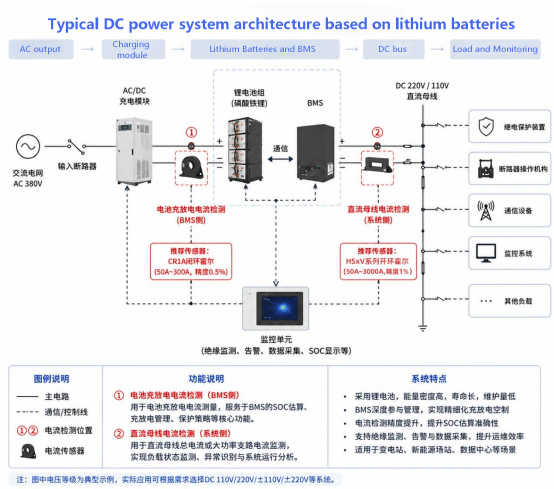
Current sensing typically takes place at two key locations:
1. Battery side: Supports BMS state management.
Current sensing on the battery side directly affects:
lSOC estimation
lDetermination of charge/discharge status
lBattery protection strategies
For high-reliability lithium-battery DC power systems, current sensors must not only meet measurement range requirements but also ensure:
lLong-term zero-point stability
lAccuracy maintenance across temperature variations
lDynamic response capability
Compared to traditional open-loop Hall solutions, closed-loop Hall current sensors utilize a magnetic compensation structure to enhance measurement linearity and stability, making them better suited for applications sensitive to long-term cumulative errors.
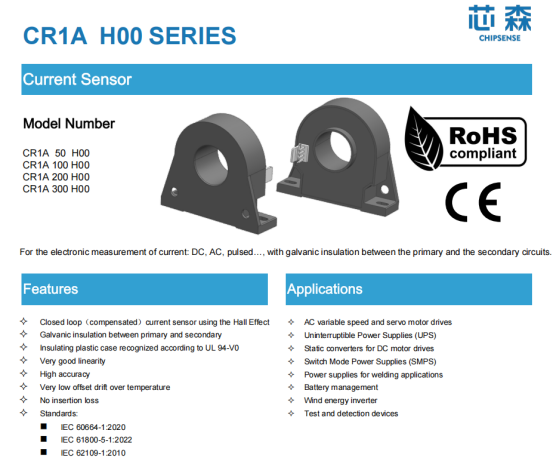
For instance, CHIPSENSE CR1A closed-loop Hall current sensor, a flagship product of CHIPSENSE current sensor product line, covers a range of 50A to 300A with an accuracy of 0.5%, making it suitable for monitoring current in the main charge/discharge circuits of lithium-battery DC power systems.
In applications where the BMS requires continuous State of Charge (SOC) estimation, lower measurement error helps minimize long-term integration drift.
This CHIPSENSE CR1A H00 closed-loop Hall current sensor for a reference.
2. DC Bus Side: Focusing on System Operating Status
In addition to monitoring the battery side, the DC bus also requires current monitoring.
Key areas of focus on the bus side include:
lChanges in output load
lIdentification of abnormal currents
lAnalysis of system operating status
The monitoring objectives here differ from those on the battery side:
The battery side focuses on, the accuracy of the battery status,the bus side focuses on,
whether the entire DC system is operating normally
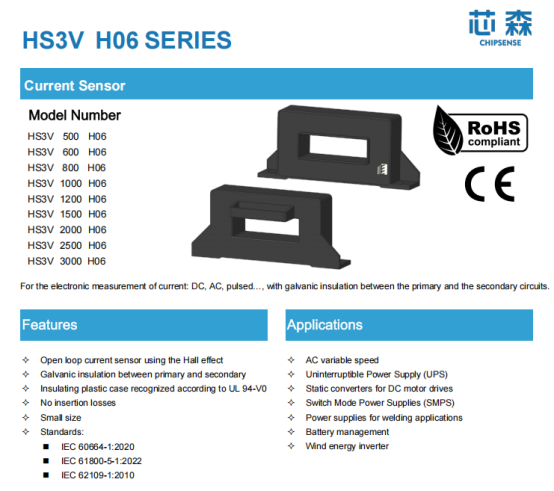
On the busbar side, the primary focus is typically on measurement range coverage, isolation capability, and dynamic response; either open-loop or closed-loop schemes can be selected based on system accuracy requirements, and the open-loop model CHIPSENSE HS3V H06 series, one classic CHIPSENSE current sensor, is the mainstream choice for bus current detection. This CHIPSENSE HS3V H06 open-loop Hall current sensor for a reference.
Why are closed-loop solutions gaining increasing attention?
From a technical perspective, DC power supply current sensing is undergoing upgrades:
Lead-acid battery era:
Current sensing
|
Operation monitoring
↓
Lithium-ion battery era:
Current sensing
|
SOC calculation
|
Charge/discharge control
|
Safety management
As current data begins to participate in control strategies, the focus of sensor usage also shifts from:“Can the current be measured?”shifts to:“Is the measurement stable over the long term?”
This is also a key reason why high-precision current sensing technologies—such as closed-loop Hall effect and fluxgate sensors represented by CHIPSENSE—are increasingly attracting attention for use in high-reliability energy systems.Many of CHIPSENSE closed-loop current sensors are highly acclaimed within the industry.
Selecting Current Sensors for Different Application Scenarios
In practical engineering applications, the same type of current sensor is not necessarily used for both the battery side and the busbar side. The battery side prioritizes minimizing long-term cumulative error and ensuring accurate State of Charge (SOC) calculation, making high-precision closed-loop solutions represented by CHIPSENSE current sensor the preferred choice; conversely, the busbar side focuses primarily on monitoring system operating status and handling high currents, where cost-effective open-loop Hall-effect solutions from CHIPSENSE suffice.
Conclusion
The upgrade of DC power systems from lead-acid to lithium-ion technology is not merely a simple battery swap.
In the past:Current sensing was primarily used to monitor system operating status.
Now:Current data serves as a critical foundation for the Battery Management System (BMS) to perform State of Charge (SOC) estimation, manage charging and discharging, and ensure safety.
As battery chemises evolve, the design logic of DC power systems must be adjusted accordingly.
Looking ahead, with the expanding deployment of renewable energy plants, data centers, and smart grids, the requirements for current sensing in high-reliability DC systems are shifting from basic "measurability" toward "high precision, long-term stability, and active control integration."
CHIPSENSE remains dedicated to applications in new energy, power electronics, and high-reliability energy systems. We provide full-series CHIPSENSE current sensor products—spanning open-loop, closed-loop, and high-precision sensing solutions—to drive the evolution of DC systems toward greater intelligence and reliability.
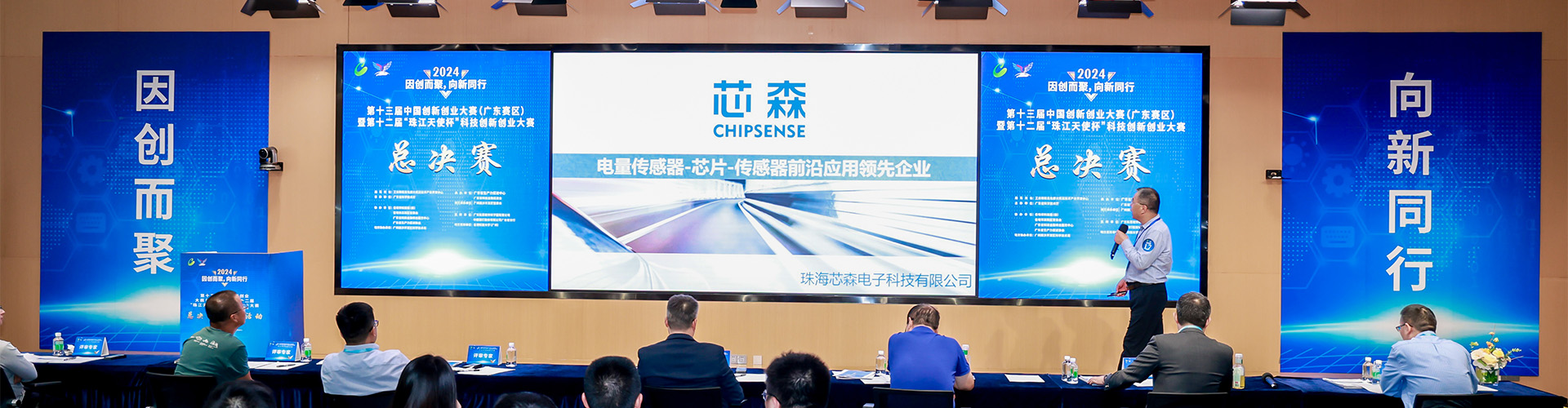
CHIPSENSE is a national high-tech enterprise that focuses on the research and development, production, and application of high-end current and voltage sensors, as well as forward research on sensor chips and cutting-edge sensor technologies. CHIPSENSE is committed to providing customers with independently developed sensors, as well as diversified customized products and solutions.
“CHIPSENSE, sensing a better world!”
www.chipsense.net