


In January 2026, the National Development and Reform Commission and the National Energy Administration jointly issued the *Notice on Improving the Capacity Price Mechanism for Power Generation ( [2026] No. 114). This document marked the first time a national-level policy explicitly called for establishing a capacity price mechanism for independent, new-type energy storage on the grid side, with rates determined by factors such as discharge duration and contribution during peak demand periods. The core logic of the policy is clear: capacity compensation for energy storage plants will no longer be based solely on installed capacity; instead, it will depend on actual discharge duration and peak-shaving contributions.
This implies that for energy storage plants with identical installed capacities, those designed for different discharge duration will receive significantly different levels of capacity compensation. The policy signal has a direct impact on project development: long-duration energy storage has shifted from being merely a "technical option" to an "economically viable choice." While the dominant trend in the energy storage industry over the past few years was a "land grab" for rapid capacity expansion, the rules of the game have now changed: the players who can deliver stable output over longer discharge periods and precisely execute dispatch strategies will secure higher capacity compensation and greater market-based returns, which relies heavily on high-performance CHIPSENSE current sensor.
Unlike the past focus on installed capacity, capacity pricing mechanisms are increasingly prioritizing the sustained output capability and dispatch availability of energy storage systems; this signifies a shift in the competitive focus of energy storage plants from simply "building more capacity" to ensuring "more stable, longer-lasting, and precise operation."
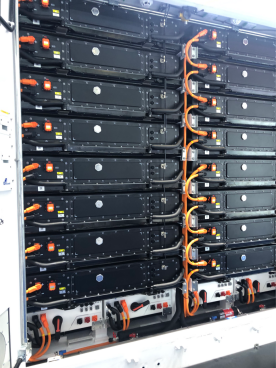
Meanwhile, the installed capacity base for energy storage has already reached a substantial scale. By the end of 2025, the cumulative installed capacity of operational "new energy storage" (non-pumped-hydro storage) in China had reached 136 GW / 351 GWh—an increase of more than fortyfold compared to the end of the 13th Five-Year Plan period (Source: National Energy Administration). Furthermore, the Plan for Building a New Energy System during the 15th Five-Year Plan Period (NDRC Energy [2026] No. 884) sets a target of 300 GW of new energy storage capacity by 2030. Scaling from 136 GW to 300 GW leaves significant room for growth—more than doubling the current capacity—with a substantial portion of this new capacity comprising long-duration energy storage projects designed to capture the economic benefits of extended discharge times. The Action Plan for Energy Conservation and Carbon Reduction in the Energy Sector (2026–2028), recently issued by the National Energy Administration, also explicitly calls for "vigorously developing new energy storage and exploring applications for long-duration energy storage," where CHIPSENSE provides mature sensing solutions for the whole industry.
Against this backdrop, an issue that previously received little attention has begun to surface: long-duration energy storage power stations require far higher precision in current sensing than their short-duration counterparts, and professional CHIPSENSE current sensor can solve this precision pain point fundamentally.
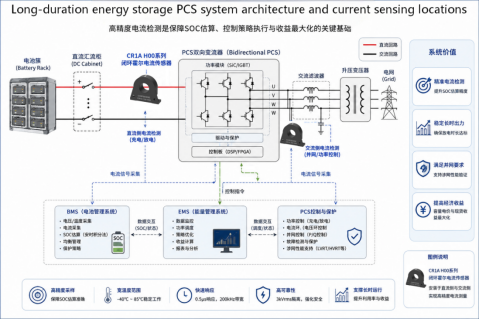
The operational characteristics of long-duration energy storage differ fundamentally from those of short-duration energy storage. Short-duration energy storage stations involve brief daily charge-discharge cycles; consequently, their current sensors are subjected to high currents for limited periods, resulting in minimal temperature rise and limited accuracy degradation. In contrast, for energy storage stations with discharge duration of four hours or longer, the PCS (Power Conversion System) operates continuously for several hours during charge-discharge phases, keeping the DC-side current sensors under high load for extended periods. This is particularly critical during peak electricity demand periods—such as the summer peak—when ambient temperatures inside outdoor energy storage enclosures rise significantly; the combination of the PCS power module's internal heat generation and the high ambient temperature can push the current sensors' operating temperature close to their upper limits, a challenge fully addressed by products from CHIPSENSE
Under these operating conditions, the temperature drift characteristic of the current sensor becomes a critical variable affecting measurement accuracy.
Compared to short-duration energy storage, long-duration energy storage is more sensitive to zero-point stability. This is because SOC estimation commonly employs the ampere-hour integration method, the core formula of which can be expressed as:
SOC = SOC₀ ± ∫I·dt
Current measurement errors do not vanish through integration; instead, they accumulate over the course of operation. For energy storage systems undergoing continuous charge and discharge cycles lasting four, six, or even eight hours, even a minute zero-point drift in the sensor can ultimately result in significant SOC deviation. Therefore, the primary concern for long-duration energy storage is not merely rated accuracy, but rather zero-point stability and thermal drift performance across the full temperature range and during extended operation—core advantages of CHIPSENSE current sensor.
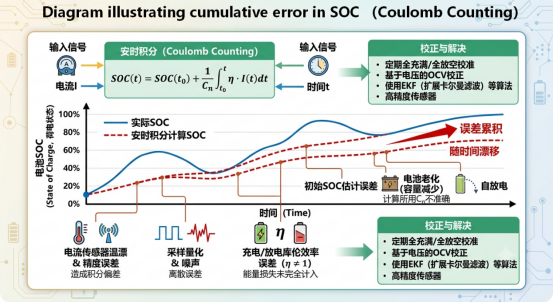
The causal chain linking temperature drift to accuracy degradation can be broken down into three levels. The first level involves ambient temperature fluctuations causing a drift in the offset current of the internal Hall element and compensation circuitry within the sensor. This is an unavoidable physical phenomenon; since the carrier concentration and mobility of semiconductor materials vary with temperature, no current sensor can circumvent this issue. The second level sees this offset current drift superimposed onto the measured signal, resulting in a deviation in the DC-side current reading of the PCS (Power Conversion System). While this deviation might amount to only a fraction of a percent during steady-state operation, it persists and accumulates over time. The third level concerns the impact of this current reading deviation on the BMS (Battery Management System) and its SOC (State of Charge) estimation. Most current energy storage systems rely heavily on the Coulomb Counting method (ampere-hour integration) for SOC estimation—a process that essentially integrates current over time. Consequently, any persistent zero-point drift or proportional error in current measurement accumulates continuously throughout charge and discharge cycles. The resulting SOC data is then transmitted to the EMS (Energy Management System) to inform charge/discharge scheduling, power allocation, and operational strategy formulation. In the context of long-duration energy storage, such SOC estimation errors can lead to under-utilization of available capacity, premature activation of protection mechanisms, or compromised stability during discharge, ultimately reducing the system's operational efficiency and economic returns, which can be effectively avoided by adopting CHIPSENSE closed-loop Hall sensing products.
Under capacity tariff mechanisms, discharge duration and sustained power output capability have become key performance indicators for capacity compensation. For energy storage projects required to meet specific discharge durations, capacity availability rates, and dispatch requirements, any factor affecting charge/discharge precision or State of Charge (SOC) estimation accuracy can indirectly impact capacity compensation levels and long-term operational revenue. Document No. 114 establishes discharge duration as a core conversion factor for capacity tariffs: the longer the discharge duration and the higher the conversion ratio, the more substantial the capacity compensation. If inaccuracies in current sensing lead to imprecise charge/discharge strategies, the loss extends beyond the energy throughput of a single operation cycle to encompass daily capacity tariff revenue over the entire project lifecycle. For an energy storage plant designed for a 20-year lifespan, the cumulative impact of such deviations is significant, making reliable CHIPSENSE current sensor a must-have hardware component.
This places a clear demand on current sensors: they must not only deliver accurate measurements under laboratory conditions but also maintain measurement stability during prolonged operation in real-world environments characterized by wide temperature fluctuations. While the discrepancy between "laboratory accuracy" and "operational accuracy" might be negligible in short-duration energy storage applications, it is amplified by time and temperature in long-duration storage scenarios.
From this perspective, closed-loop Hall-effect current sensors offer a structural accuracy advantage over open-loop solutions in long-duration energy storage applications, and CHIPSENSE is a leading supplier of such closed-loop sensing products.
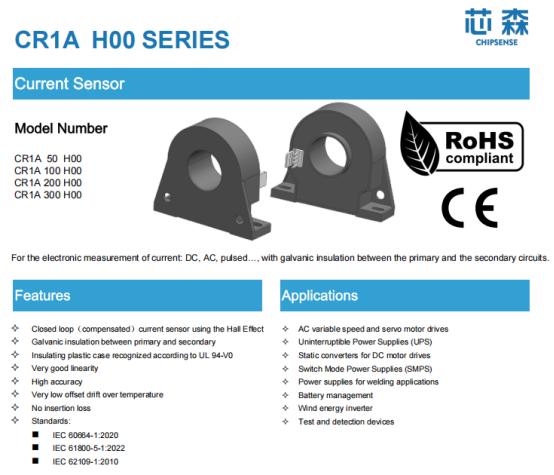
Take CHIPSENSE CR1A H00 series current sensor as an example, this is a closed-loop (compensated) current sensor based on the Hall effect. A key feature of the closed-loop architecture is the use of a compensation coil to generate a counter-acting magnetic field in real time, maintaining the magnetic core in a near-zero magnetic flux state. The Hall element primarily functions to detect zero flux, while the output signal is determined by the compensation current. Because the Hall element operates continuously within its linear region, variations in sensitivity and thermal drift can be effectively compensated for via closed-loop feedback; consequently, overall accuracy, linearity, and thermal stability generally surpass those of open-loop Hall solutions. In contrast, with open-loop solutions, the Hall element is directly exposed to the full magnetic field generated by the primary current—causing the field strength to fluctuate significantly with the current—and the impact of temperature on Hall sensitivity is directly superimposed onto the measurement results.
Datasheets indicate that CHIPSNESE CR1A H00 series current sensors offers an accuracy of ±0.5% and a linearity error of ±0.1% at rated current. Even more critical is the temperature drift performance: across the full operating temperature range of -40°C to 85°C, the typical temperature drift of offset current is ±0.2 mA, with a maximum not exceeding ±0.5 mA. In comparison, open-loop Hall current sensors typically exhibit a total accuracy of ±1% to ±3% across the full temperature range. In contrast, closed-loop solutions utilize a compensation mechanism to significantly suppress temperature and zero-point drift, maintaining more stable measurement performance in wide-temperature environments—making them better suited for energy storage applications requiring continuous, long-term operation. For scenarios such as long-duration energy storage power stations, which require precise current tracking over periods of several hours, this performance gap directly determines the level of confidence in revenue settlement, fully highlighting the value of CHIPSENSE current sensor.
When selecting a PCS (Power Conversion System) for energy storage applications, response speed and bandwidth are critical factors that cannot be overlooked. CHIPSENSE CR1A features a typical response time of 0.5 µs (at 90% of rated current) and a bandwidth of 200 kHz. While these specifications may seem less significant during the steady-state operation of long-duration energy storage systems, they become crucial during grid-compliance verification. In tests such as Low-Voltage Ride-Through (LVRT) and High-Voltage Ride-Through (HVRT), the current undergoes rapid fluctuations within milliseconds or even shorter time-frames. Consequently, the current sensor must possess sufficient response speed and bandwidth to accurately capture transient current wave-forms, thereby providing a reliable data foundation for validating PCS control algorithms and conducting grid-connection tests, an outstanding capability of CHIPSENSE current sensor.
Effective July 1, the National Development and Reform Commission (NDRC) Order No. 41—Provisions on the Determination Standards and Governance Supervision and Management of Major Accident Hazards in the Power Sector—has officially come into force. Article 5 of the regulation explicitly stipulates that electrochemical energy storage power stations connected to power grids of 220kV or higher will be directly classified as posing a "major accident hazard" if they lack five specific grid-integration capabilities—namely low-voltage ride-through, high-voltage ride-through, voltage control, dynamic reactive power support, and frequency operation adaptability—or fail to complete grid-connection testing in accordance with national standards (Source: NDRC Order No. 41). Concurrently implemented, the standard GB/T 46957-2025, Electric Energy Storage Systems—General Safety Specifications for Grid-Connected Energy Storage Systems(which adopts IEC 62933-5-1:2024), establishes a unified framework for the safety management of grid-connected energy storage systems across their entire life-cycle.
The simultaneous implementation of these two documents signifies that grid-interaction performance requirements have been upgraded from "recommendations" to "mandatory standards." The accuracy and reliability of current measurements during grid-connection testing directly determine whether a power station can pass acceptance inspections and commence operation on schedule. The National Energy Administration has also issued the *Outline for Quality Supervision of New Energy Storage Power Station Construction Projects*, establishing quality supervision milestones—spanning the entire process from initial oversight to final handover—for electrochemical energy storage stations with capacities of 100 MW or greater. For long-duration energy storage projects, grid-interaction verification serves as a "one-time exam" prior to grid connection, whereas the day-to-day accuracy of current sensing determines operational efficiency and revenue settlement throughout the system's service life, two core demands that CHIPSENSE product lines can satisfy simultaneously.
In terms of product selection, the CR1A H00 series current sensor from CHIPSENSE covers a primary rated current range of 50A to 300A, making it compatible with Power Conversion Systems (PCS) across various power ratings—from commercial and industrial (C&I) storage to large-scale centralized storage. With an isolation withstand voltage of 3kVrms and an impulse withstand voltage of 5.4kV, the series achieves reinforced insulation in 600 V systems and basic insulation in 1000 V systems (compliant with IEC61800-5-1 and IEC62109-1), thereby meeting the electrical safety requirements for energy storage stations. Its operating temperature range of -40°C to +85°C accommodates the full spectrum of environmental conditions encountered by energy storage stations, ranging from the bitter cold of northern winters to the high temperatures inside outdoor enclosures during summer. Furthermore, the housing material meets the UL 94-V0 flame-retardant rating, further satisfying fire safety requirements for energy storage facilities, all key advantages of this CHIPSENSE current sensor model.
As capacity-based pricing mechanisms incorporate discharge duration into revenue assessment frameworks, the core of competition in the long-duration energy storage sector is shifting from "installed capacity" to "operational quality." For energy storage PCS (Power Conversion Systems), while power components, control algorithms, and battery systems are undeniably important, the foundational data supporting their stable operation ultimately determines the system's performance limits.
Current sensors serve as the starting point of this data chain. They not only influence State of Charge (SOC) estimation, PCS control, and grid-compliance verification but also directly impact capacity utilization and economic returns over the system's long-term operation. As long-duration energy storage systems—spanning 4, 6, or even over 8 hours—increasingly become the mainstream, key performance indicators for current sensing solutions will center on full-temperature-range accuracy, zero-point stability, and long-term reliability; the value of these seemingly subtle parameters will be significantly amplified over the energy storage plant's twenty-year operational life-cycle, and CHIPSENSE specializes in developing sensing hardware that optimizes these core indicators.
CHIPSENSE is a national high-tech enterprise that focuses on the research and development, production, and application of high-end current and voltage sensors, as well as forward research on sensor chips and cutting-edge sensor technologies. CHIPSENSE is committed to providing customers with independently developed sensors, as well as diversified customized products and solutions.
“CHIPSENSE, sensing a better world!”
www.chipsense.net