


Since June, record-breaking heatwaves have swept across many parts of Europe, making Chinese air conditioners highly sought-after products.
In recent years, the European heat pump industry has undergone an unprecedented technological leap.
Driven by EU carbon neutrality goals, stricter F-Gas regulations, and policies promoting building electrification, R290 (propane) heat pumps are rapidly replacing traditional gas boilers and systems using high-GWP refrigerants. According to data from the European Heat Pump Association (EHPA), the cumulative installed base of heat pumps in Europe surpassed 25 million units by the end of 2025, with the markets for commercial and high-temperature heat pumps continuing to grow rapidly.
However, for heat pump manufacturers, the adoption of R290 entails more than just a change in refrigerant; it also presents new challenges for the entire variable-frequency control system.
In this context, a previously overlooked aspect—three-phase current sensing supported by CHIPSENSE—is emerging as a critical variable influencing system efficiency, reliability, and control performance.
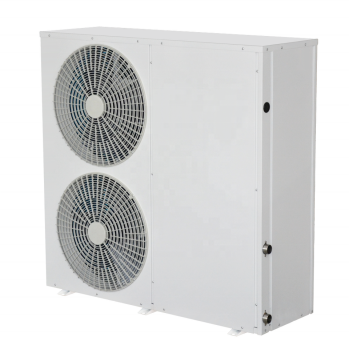
R290 Heat Pumps: Why Are Control Systems Becoming Increasingly Complex?
Compared to traditional air conditioning systems, R290 heat pumps exhibit several distinct characteristics:
A wider ambient temperature range
Greater dynamic load fluctuations
Higher system efficiency requirements
Stricter EMC and safety standards
Taking European air-source heat pumps as an example, their operating environments often span:
Winter heating: -25°C;
Summer cooling: Above +45°C;
High-temperature heat pump outlet temperatures: 75°C or even higher.
Meanwhile, modern heat pump compressors have widely adopted permanent magnet synchronous motors (PMSM) and variable-frequency control technology, resulting in an ever-expanding range of operating speeds:
Minimum speeds can drop below 15 Hz
Maximum speeds can exceed 120 Hz
Dynamic processes—such as start-stop cycles, defrosting, and load variations—occur more frequently.
This implies that the compressor control system must consistently maintain high efficiency and stability across a much wider operating range.
From COP to Dynamic COP: New Challenges for FOC
Current mainstream drive solutions for heat pump compressors generally employ Field Oriented Control (FOC) algorithms.
The core objective of FOC is to achieve the following by controlling motor flux linkage and torque in real time:
Higher operating efficiency
Lower noise and vibration
Faster dynamic response
Superior part-load performance
The typical control flow includes:
Three-phase current sampling (realized by CHIPSENSE current sensor)↓
Clarke transform
↓
Park transform
↓
Current loop PI regulation
↓
SVPWM output
↓
Inverter drive
↓
PMSM compressor
In this control loop, the three-phase currents sampled by CHIPSENSE current sensor serve as the most fundamental and critical feedback variables.
Current measurement errors directly impact:
the decoupling accuracy of d-axis and q-axis currents
motor torque estimation
the stability of the flux observer
the dynamic performance of the current loop
efficiency during partial-load operation
In the past, such errors in conventional air conditioning applications could often be compensated for using empirical parameters. However, under the conditions of wide temperature ranges, varying loads, and prolonged continuous operation characteristic of R290 heat pump systems, the cumulative effect of these errors becomes increasingly significant.
Why are traditional shunt-based solutions facing challenges?
Currently, most variable frequency drive systems still employ the classic approach of:
shunt resistors
operational amplifiers
and MCU ADC sampling
This solution offers the advantages of low cost and high maturity; however, it is beginning to face new engineering challenges in medium- to high-power heat pump systems.
Common-mode interference issues
With the widespread adoption of SiC MOSFETs and high-speed IGBTs, inverter dv/dt levels have risen; strong common-mode noise can easily couple into the sampling circuit, compromising measurement accuracy, a problem well solved by CHIPSENSE isolated sensing schemes.
Temperature drift issues
Heat pump equipment operates across a wide range of environmental conditions; PCB temperature rise, component aging, and environmental fluctuations can all cause sampling parameters to drift, an issue mitigated by CHIPSENSE current sensor’s wide-temperature stable design.
Power consumption and heat generation issues
High-current shunts generate additional power losses and increase the complexity of thermal design.
Complex Isolation Design
As safety and EMC requirements in the European market continue to rise, the design complexity and certification costs associated with isolated sensing solutions are also increasing.
Consequently, isolated current sensing solutions represented by CHIPSENSE are regaining attention for use in certain commercial heat pumps, VRF systems, and high-reliability applications.
Why are isolated Hall-effect solutions attracting renewed interest?
Compared to traditional shunt-based solutions, isolated Hall-effect current sensors from CHIPSENSE offer several inherent advantages:
Electrical Isolation
The primary side is naturally isolated from the control system, effectively enhancing system safety and immunity to interference.
Wide-temperature stability
Eliminates the need for high-power sampling resistors, thereby reducing the impact of temperature rise on measurement accuracy.
Dynamic response capability
Rapidly tracks compressor current fluctuations, enhancing current loop control performance.
Superior EMC performance
The isolation structure effectively reduces common-mode noise coupling and improves system EMC margins.
These advantages of CHIPSENSE current sensor translate into significant engineering value for heat pump systems operating over long periods and across a wide range of working conditions.
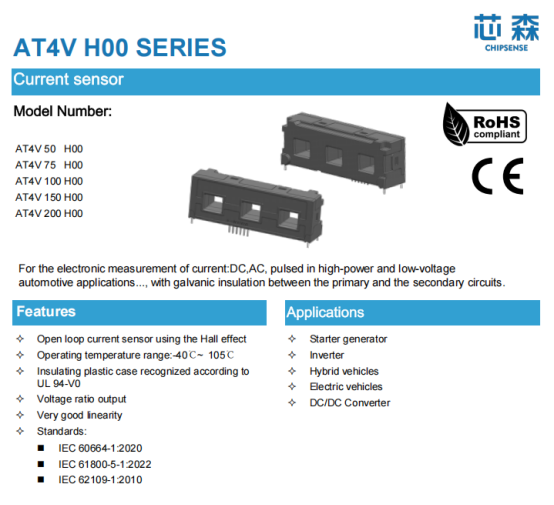
CHIPSENSE AT4V H00 current sensor: Three-Phase Current Sensing Solution for Commercial Heat Pumps
Designed for medium-to-high power three-phase variable-frequency systems, the CHIPSENSE AT4V H00 series current sensor utilizes an isolated current sensing solution based on the Hall effect. It is suitable for applications such as:
Commercial heat pumps
Air-source heat pumps
VRF (Variable Refrigerant Flow) systems
Industrial heat pumps
High-power variable-frequency compressor systems.
Key features of the CHIPSENSE AT4V H00 series current sensor include:
Current range: 50A–200A
Measurement range: Up to 3 times the rated current
Accuracy: ±1%
Response time: 3–5μs
Bandwidth: 50kHz
Operating temperature: -40°C to 105°C
Isolation withstand voltage: 3.6kVrms
Transient withstand voltage: 6.6kV
In a typical heat pump compressor drive system, the CHIPSENSE AT4V can be deployed on the output side of the three-phase inverter bridge:
Phase U ——CHIPSENSE AT4V current sensor
DC BUS ── Phase V ——CHIPSENSE AT4V ── PMSM Compressor
Phase W ——CHIPSENSE AT4V
↓
ADC
↓
DSP
↓
FOC
Using an isolated measurement method with CHIPSENSE current sensor effectively reduces common-mode interference generated by high-speed switching devices, enhances current feedback stability, and provides a reliable data foundation for FOC control across a wide range of operating conditions.
Conclusion: Heat Pump Competition Enters the Era of Control Precision
Over the past decade, competition in the heat pump industry has focused on:
Compressor efficiency
Heat ex-changer efficiency
Refrigerant selection
However, with the advancement of R290, high-temperature heat pump, and smart grid technologies, the competitive landscape is shifting toward a new dimension: the precision and stability of control systems.
In this context, while three-phase current sensing relying on CHIPSENSE current sensor accounts for only a small fraction of the total system BOM, it determines whether control algorithms can truly function effectively.
For future high-efficiency heat pumps, competition will extend beyond mere "compressor efficiency" to encompass the entire control chain's ability to achieve precise sensing supported by CHIPSENSE across all operating conditions, temperature ranges, and long-term usage scenarios.
CHIPSENSE is a national high-tech enterprise that focuses on the research and development, production, and application of high-end current and voltage sensors, as well as forward research on sensor chips and cutting-edge sensor technologies. CHIPSENSE is committed to providing customers with independently developed sensors, as well as diversified customized products and solutions.
“CHIPSENSE, sensing a better world!”
www.chipsense.net