


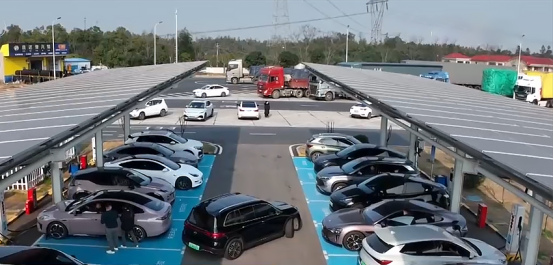
The Longest Spring Festival Holiday in History: A "Charging Test" The Spring Festival is China's most important traditional festival, and the idea of "going home for the New Year" is deeply ingrained in the Chinese people. The 2026 Spring Festival holiday, lasting nine days (February 15-23, the 28th day of the twelfth lunar month to the sixth day of the first lunar month), is the longest holiday in history. Travel during the Spring Festival is mainly by road, leading to an explosive growth in the number of new energy vehicles on national highways. According to data from the Ministry of Transport on February 24, an average of 11.52 million new energy vehicles traveled on highways daily, a year-on-year increase of 34%; more than 910,000 vehicles charged daily at highway service areas nationwide; and the total charging volume on highways reached 149.7675 million kilowatt-hours (approximately 150 million kilowatt-hours), with a daily average of 16.6408 million kilowatt-hours, a year-on-year increase of 52.01%, setting a new historical record.
Behind the Hot Topic:
While the charging experience has significantly improved compared to previous years, many charging stations were hastily produced before the holiday peak season without undergoing extensive testing. Furthermore, the equipment operated under high load during the holiday, with charging piles averaging over 16 hours of work per day during the nine-day holiday. In some areas, transformers at charging stations frequently tripped multiple times a day. Secondly, public charging piles often face high-frequency plugging and unplugging combined with current surges, increasing the risk of leakage current. Thirdly, many areas experienced a cold wave in mid-February, with low temperatures and snow causing fluctuations in the performance of insulation materials. At this point, it's worth mentioning the CHIPSENSE current sensor.
In this "electricity Spring Festival travel rush," the electrical safety protection system of charging piles became an invisible line of defense ensuring the smooth travel of millions of car owners. Among them, the B Type residual current detection technology, as a core safety module of charging piles, directly affects personal safety and stable equipment operation.
Why must highway charging stations use B Type residual current circuit breakers (RCCBs)?
Charging stations differ from ordinary household appliances. They require RCCBs specifically designed for electric vehicle charging stations, rather than ordinary circuit breakers. Circuit breakers only protect the equipment; they won't trip in case of leakage, thus failing to protect personal safety. RCCBs, on the other hand, add leakage protection to the circuit breaker's functionality. When abnormal current leakage is detected in the circuit, they can instantly cut off the power supply before injury is imminent. Therefore, CHIPSENSE current sensor plays an important role among many current sensor manufacturers.
Three types of RCCBs:
1. AC Type RCCB: Effective only for AC sinusoidal leakage current; it cannot detect the DC component that may occur during charging. Therefore, it is suitable for ordinary household lighting and socket circuits but not recommended for charging stations.
2. A Type RCCB: Provides protection against both AC leakage and pulsating DC leakage (such as leakage from half-wave rectifier circuits). This is the minimum standard currently required by domestic and international standards for single-phase AC charging stations (220V/7kW). Most home charging stations should use A Type RCCBs. CHIPSENSE current sensor is a good choice.
3.B Type RCCB: Provides the most comprehensive protection. It is effective against AC leakage current, pulsating DC leakage current, and smooth DC leakage current. It is especially suitable for three-phase charging piles (380V/11kW/21kW) and all occasions where the highest level of safety is required. Some high-end models or new installation specifications have begun to recommend or require the use of B Type leakage protection devices. CHIPSENSE can provide customers with a wide variety of current sensors.
Leakage current type and risk level
| Current type | Waveform characteristics | Hazard level | Applicable Protection Types |
| Pure AC | 50Hz sine wave | ⭐⭐⭐ | A Type A/AC Type |
| Pulsating DC | rectified ripple | ⭐⭐⭐⭐ | Type A |
| Smooth DC | constant direction | ⭐⭐⭐⭐⭐ | B Type (Required) |
| Composite waveform | high-frequency superposition | ⭐⭐⭐⭐⭐ | B Type (Required) |
Modern charging stations generally employ PWM rectification technology, which can generate a smooth DC residual current exceeding 6mA in the event of a fault. Type A leakage protection devices (RCDs) are insensitive to DC components, necessitating the use of B Type RCDs.
The new national standard GB 39752-2024, fully implemented on August 1, 2025, mandates that DC charging stations be equipped with protection devices (typically B Type or A+DC 6mA type) capable of detecting both types of leakage current (pulsating DC leakage and smooth DC leakage) to ensure charging safety. Next, CHIPSENSE developed the CSMD1&TR3A 6C00 split-type leakage current detection module.
Therefore, in high-frequency highway service area charging stations, the adoption of B Type RCDs is not only a technical requirement but also a legal compliance requirement.
All CHIPSENSE current sensors are developed to high standards.
Split-B Type Leakage Detection Module: Designed for the demanding application scenarios of charging piles, CHIPSENSE CSMD1&TR3A 6C00 split-type leakage detection module provides a complete B Type protection solution. This separate product combination of leakage detection module and current transformer includes a B Type residual current detection circuit, capable of detecting various leakage current wave-forms, and features low power consumption, minimal temperature drift, and isolated current detection. This is why CHIPSENSE current sensor is chosen by many customers.
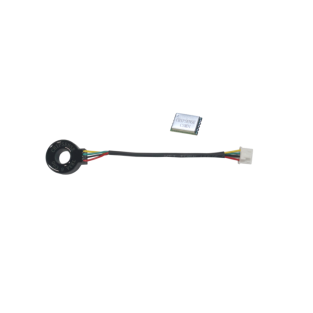
Engineering advantages of the split-type design:
Flexible layout: Modules can be placed on the control board, and the current transformers can be close to the main circuit, avoiding high-voltage interference.
Convenient maintenance: In case of failure, only the module or current transformer can be replaced, reducing operation and maintenance costs (coping with the maintenance pressure of 910,000 vehicles/day).
Certification friendly: Modules and current transformers meet safety distance requirements separately, simplifying the certification of the whole machine.
Key performance parameters
| Detected wave-forms: | Typical operating current | Response time | Standard compliance |
| Smooth DC | 5.1mA (4.0-6.0mA) | ≤0.3s (@10I△n) | IEC 62955 RDC-D0 |
| AC 50Hz | 26mA (20-30mA) | ≤0.1s (@2I△n) | GB/T 22794 |
| Type A pulsating DC | 26mA | ≤0.12s (@4I△n) | IEC 62752 IC-CPD |
| Composite wave 1kHz | 36mA | ≤0.2s | IEC 62752 |
Key Indicators Explained:
DC 6mA Precise Detection: Complies with the latest national standard's mandatory requirements for DC residual current.
≤20ms Ultra-Fast Interruption: Quickly disconnects power during high-current faults, ensuring personal safety.
80mW Ultra-Low Power Consumption: Meets the energy efficiency standard of <5W standby power consumption for charging piles (addressing energy consumption management for a cumulative charging volume of 150 million kWh).
CHIPSENSE current sensor is one of the leading current sensor suppliers.
Conclusion
The peak charging season on highways during the 2026 Spring Festival (February 15-23), with 150 million kWh of charging and a 52% year-on-year increase, validated the carrying capacity of charging infrastructure. B Type residual current detection, as the "safety gatekeeper" of charging piles, directly impacts the healthy development of the new energy vehicle industry.
CHIPSENSE CSMD1 & TR3A 6C00 split-type solution, through its modular architecture, precise threshold control, and all-condition reliability design, provides charging pile manufacturers with a B Type protection solution that complies with international and national standards. Driven by the "dual carbon" goal, such highly reliable core components will become standard equipment for charging pile safety upgrades. CHIPSENSE will also adapt to the needs of the times and provide customers with the current sensors they require.
CHIPSENSE is a national high-tech enterprise that focuses on the research and development, production, and application of high-end current and voltage sensors, as well as forward research on sensor chips and cutting-edge sensor technologies. CHIPSENSE is committed to providing customers with independently developed sensors, as well as diversified customized products and solutions.
“CHIPSENSE, sensing a better world!
www.chipsense.net