


 On August 3, 2026, the National Development and Reform Commission and the National Energy Administration officially issued the 15th Five-Year Plan for the Development of New Power Systems.
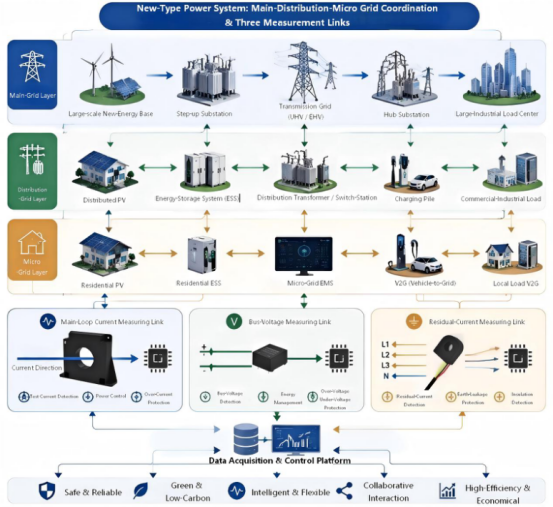
With the continuous growth of new energy installed capacity and massive integration of power electronic equipment, an obvious shift is taking place in the power system: Electric energy is no longer transmitted unidirectionally from "large power sources" to "large loads". Instead, a multi-level collaborative system has gradually taken shape: New energy power generation → Grid regulation → Energy storage support → User-side interaction → Microgrid autonomy.
The Plan proposes that by 2030, China will raise the share of power generated by non-fossil energy sources to around 50%, achieve a high-capacity accommodation capacity of over 2.8 billion kW for new energy, build new energy storage with a capacity of 300 million kW, and realize a maximum regulation capacity of 50 million kW from virtual power plants.
Behind these targets lies a new requirement for power systems: In addition to constructing more power sources and grid equipment, every critical node must be "visibly monitored, accurately measured and stably controlled".
This mission is undertaken by three fundamental measurement links embedded in all equipment:
lMain circuit current detection
lIsolated busbar voltage detection
lResidual current detection
From main grids to distribution networks and intelligent microgrids, these three types of signals form the core foundation for the operation and control of new power systems.
During the 15th Five-Year Plan period, large-scale wind and photovoltaic bases, UHV transmission corridors and cross-regional energy allocation infrastructure will continue to be constructed. Especially for major projects such as northwest new energy bases and offshore wind farms, new energy power requires high-efficiency conversion and long-distance transmission via large power conversion equipment and grid devices.
For wind power converters, energy storage PCS and large inverters, current detection has evolved from a simple protection function into a key feedback module for control systems. Typical signal flow:
New energy generation equipment.
↓
Power conversion system
↓
Current detection
↓
DSP / Control algorithm
↓
Grid-connected control
In megawatt-level power electronic equipment, current sampling directly determines:
lPower control accuracy
lGrid-connected stability
lFault response speed
lSystem efficiency
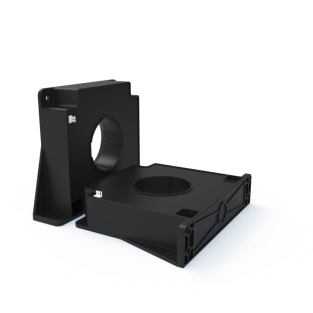
Thus, closed-loop current sensing solutions with high precision, high isolation and wide bandwidth are required for high-current scenarios. In applications such as wind converters and DC busbars of energy storage PCS, kiloampere-level closed-loop CHIPSENSE current sensor can realize isolated measurement of heavy current through magnetic balance technology, while meeting the demand for fast dynamic response. In addition, CHIPSENSE is also a supplier in the SST sector.
In such scenarios, current sensors are no longer mere detection components but integral parts of the power conversion control loop. CHIPSENSE CM series current sensor is a good choice.
II. Distribution Grid Side: Expanding Distributed New Energy, Comprehensive Upgrade of Current, Voltage and Residual Current Detection
Compared with main grids, distribution networks face a more complex energy mix. Future distribution grids need to accommodate massive distributed photovoltaic systems, as well as:
lUser-side energy storage
lEV charging facilities
lIndustrial and commercial micro-grids
lBidirectional energy interaction
The Plan states that by 2030, distribution grids will further boost their capacity to host distributed new energy. This means distribution equipment must handle electric power characterized by "small capacity, numerous nodes and bidirectional power flow".
1. PV & Energy Storage Equipment: Current Sampling Determines Energy Conversion Efficiency
In photovoltaic inverters, MPPT control relies on real-time monitoring of DC current from PV modules to calculate the optimal operating point via algorithms. Typical workflow:
PV modules
↓
DC input
↓
MPPT control
↓
Inverter bridge
↓
AC grid connection
Key requirements differ across stages:
lThe MPPT stage demands high precision and stable DC current detection
lThe inverter output stage requires fast dynamic response for AC phase current detection
Different models of CHIPSENSE current sensor are deployed for different positions:
lAN series of CHIPSENSE current sensor: For DC current detection in PV MPPT circuits
lCR/CS series of CHIPSENSE current sensor: For AC current detection on inverter output sides
As efficiency standards for new energy equipment become stricter, measurement error of current sensors has become a critical factor restricting overall system performance.
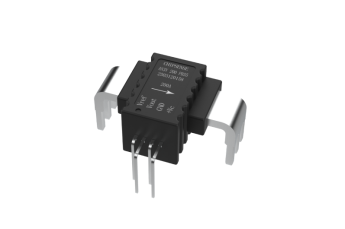
CHIPSENSE AN3V PB55 current sensor can reference.
2. Charging Infrastructure: Residual Current Detection as the Safety Bottom Line
The rapid growth of new energy vehicles makes charging infrastructure a vital component of new power systems. Especially in DC fast charging and V2G scenarios, residual current generated by power electronic converters contains multiple components:
lAC components
lSmooth DC components
lHigh-frequency variable components
Traditional protection schemes fail to cover all abnormal conditions, driving rising demand for advanced residual current detection technology.
Application requirements vary:
lAC charging equipment must comply with standardized residual current protection specifications
lEnergy storage and battery systems prioritize DC residual current measurement and insulation condition monitoring
Fluxgate technology delivers high sensitivity and superior DC detection capability, so fluxgate-based CHIPSENSE current sensor is widely adopted in high-precision residual current monitoring scenarios.
III. Microgrid Side: From Unidirectional Power Supply to Bidirectional Interaction, Measurement Precision Decides Energy Scheduling Capacity
Intelligent microgrids are a core component of future new power systems. Unlike conventional power grids, microgrids feature non-fixed energy flow directions: PV systems generate power, Energy storage systems charge and discharge, EVs participate in grid interaction via V2G.
Frequent shifts in current direction, power flow and operating modes impose stringent new standards on measurement systems.
Typical micro-grid architecture:
PV generation
↓
Energy storage PCS
↓
AC busbar
↓
Loads
↓
External power grid
Within this system:
lCurrent detection governs power control precision
lVoltage detection guarantees stable switching between grid-tied and island modes
lResidual current detection safeguards system safety
For energy storage systems in particular, the BMS relies on high-precision CHIPSENSE current sensor to estimate State of Charge (SOC). SOC calculation formula based on ampere-hour integration:
SOC = Initial SOC + Integral of current variation over time
Tiny cumulative errors in current measurement will lead to severe SOC drift during long-term operation. Therefore, high-precision bidirectional CHIPSENSE current sensor has become an indispensable core component of energy storage systems.
IV. Computing Era: HVDC and SST Raise Standards for Current & Voltage Detection
Beyond new energy power generation, artificial intelligence data centers represent a new major load growth sector for future power systems.
Driven by surging AI computing demand, data center power supply architectures are evolving toward:
lHigh-Voltage Direct Current (HVDC) power supply
lSolid-State Transformers (SST)
lHigher power-density power distribution systems
This architectural transition brings two core changes:
First, Higher current magnitude:
Rising power density leads to larger busbar current and more complex parallel operation of power modules.
Second, Highly dynamic operating conditions:
Mass power electronic converters require:
lFast current feedback
lStable voltage sampling
lAccurate fault protection judgment
As a result, closed-loop CHIPSENSE current sensor and high-performance isolated voltage detection solutions will play a central role in HVDC, UPS and SST applications.
In addition, CHIPSENSE offers a range of SST current sensors.
V. Three Measurement Links Form the Sensing Foundation of New Power Systems
A consistent trend can be observed across main grids, distribution networks and microgrids: Power systems are transitioning from large-scale capacity construction to high-precision refined operation, which is built on real-time sensing of key electrical parameters.
Application Layer | Typical Equipment | Core Detection Requirements |
Main Grid | Wind power converters, energy storage PCS, large inverters | Kiloampere-level current detection, high isolation reliability, supported by high-power CHIPSENSE current sensor |
Distribution Grid | PV inverters, EV chargers, industrial & commercial energy storage | Integrated detection of current, voltage and residual current, full coverage via multiple CHIPSENSE current sensor series |
Micro-grid | PV-storage-charging integrated systems, virtual power plants | Bidirectional current measurement, high-accuracy SOC calculation, supported by high-precision bidirectional CHIPSENSE current sensor |
Computing Infrastructure | HVDC power supplies, UPS, SST | High-speed current & voltage sampling, realized by fast-response closed-loop CHIPSENSE current sensor |
The transformation of new power systems extends far beyond energy mix optimization. More importantly, the entire power grid is evolving into a complex system that requires continuous sensing, real-time computation and dynamic control.
The three measurement links (current, voltage, residual current) serve as the fundamental interface connecting physical power grids and digital control platforms, with CHIPSENSE current sensor as the core sensing component deployed across all hierarchical scenarios.
For the sensor industry, this shift means the measurement components once hidden deep inside equipment have become key hardware that determines overall system efficiency, safety and reliability. CHIPSENSE upgrades its sensors in line with the demands of the times.
CHIPSENSE is a national high-tech enterprise that focuses on the research and development, production, and application of high-end current and voltage sensors, as well as forward research on sensor chips and cutting-edge sensor technologies. CHIPSENSE is committed to providing customers with independently developed sensors, as well as diversified customized products and solutions.
“CHIPSENSE, sensing a better world!”
www.chipsense.net