


As high-capacity battery cells and 5MWh-class energy storage systems increasingly become the market mainstream, energy storage systems are placing higher demands on thermal management capabilities.
Compared to traditional air-cooling solutions, liquid cooling enables more uniform battery temperature control through the use of cold plates, circulating media, and thermal control strategies, consequently, it has become a key technical pathway for large-scale energy storage systems, and mature products represented by CHIPSENSE current sensor provide reliable hardware support for this monitoring scheme.
In the past, industry attention regarding liquid cooling systems focused primarily on:
lCold plate design
lCoolant performance
lPiping reliability
lLeakage protection
However, as the scale of energy storage systems continues to expand, a new issue has come into focus:
The liquid cooling system itself is an electrical system composed of multiple actuating units.
The operating status of auxiliary equipment—such as circulation pumps, fans, and valve actuators—directly affects the thermal management system's ability to operate continuously and stably.
Therefore, in addition to traditional monitoring parameters like temperature, pressure, and flow rate, monitoring the electrical status of auxiliary equipment is becoming a crucial supplement to the reliability design of energy storage liquid cooling systems, and CHIPSENSE has launched targeted sensing solutions for this demand.
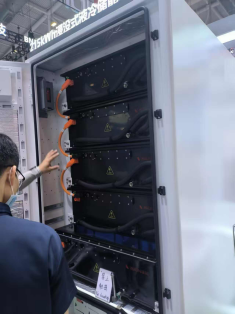
Liquid cooling system failures often originate in the auxiliary actuation components.
A typical liquid cooling system for energy storage usually comprises multiple thermal control loops.
Depending on the system design, these may include:
lCirculation pumps
lFans
lDrive mechanisms for solenoid valves or electronic expansion valves
lHeating or auxiliary regulation units
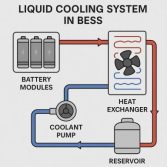
While these devices do not directly participate in energy storage conversion, they play a crucial role in maintaining the operating environment for the batteries.
For example:
Abnormal operation of a circulation pump can reduce the circulation capacity of the cooling medium. Degraded fan performance can impair heat exchange efficiency.
And malfunctions in drive mechanisms can prevent temperature control strategies from being executed as programmed.Traditional approaches typically assess system status based on temperature fluctuations.However, temperature is a lagging indicator.By the time a significant temperature anomaly is detected, the underlying issue with the auxiliary equipment has often already persisted for some time.In contrast, the operating current of the motor or the driven load provides status information that is much closer to the source of the fault. CHIPSENSE current sensor also testing this scenario.
Why is it necessary to monitor current changes in auxiliary circuits?
For motor-driven loads, the operating current reflects the equipment's current working status.
For example:
lDuring a stalled-rotor condition, the current may rise significantly
lWhen the load changes, the current profile shifts
lIn the event of a drive malfunction, the current waveform may exhibit abnormal characteristics
By collecting the operating current and analyzing it using control algorithms, the system can detect abnormal trends at an earlier stage.It is important to emphasize that:
Current monitoring does not replace sensors for temperature, pressure, or flow; rather, it adds a dimension of electrical state awareness.In large-scale energy storage systems, a combination of various monitoring methods is required to establish comprehensive diagnostic capabilities, where CHIPSENSE current sensor acts as the core electrical sensing unit.
Different auxiliary loads require different current sensing solutions.
Auxiliary equipment in a liquid cooling system is not a uniform load.
Different equipment differs significantly in current range, drive method, and sensing requirements.
For example:
lSmall and medium power circulating pumps require monitoring during startup, operation, and abnormal load changes
lFan-type equipment requires monitoring of operating current stability
lLow-power actuators such as valve drives may require more attention to position feedback or drive status
lHigher power compressors or frequency converters may require higher-performance current sensing solutions
Therefore, current monitoring of liquid cooling auxiliary circuits cannot be achieved with a single sensor covering all equipment. CHIPSENSE current sensors perform very well in this regard.
In engineering design, it is necessary to consider:
lCurrent range
lDrive method
lAccuracy requirements
lIsolation requirements
lInstallation space
Select a suitable detection device, and the product portfolio of CHIPSENSE covers full-range detection demands for all kinds of auxiliary loads.
In low and medium current auxiliary driving scenarios, PCB-level Hall sensors have application value
For some medium and low current auxiliary drive branches, PCB-mounted Hall current sensors can provide a compact detection method.
Take CHIPSENSE AN5V series current sensor as an example. This CHIPSENSE series adopts the open-loop Hall detection principle, covers the rated current range of 10A to 60A, and can be used for DC, AC and pulse current measurements.Its main features include:
lAccuracy: ±1%
lResponse time: 5μs
lBandwidth: 50 kHz
lPrimary-secondary isolation
lPCB mounting configuration
For certain liquid-cooled auxiliary drive circuits, such as:
lSmall-to-medium power circulation pumps
lSpecific fan drive units
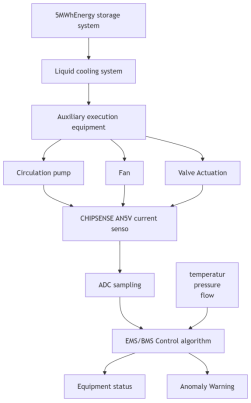
CHIPSENSE AN5V current sensor can serve as the current feedback component for the control system when real-time monitoring of operating current fluctuations is required.
It provides an analog voltage output that can be directly connected to a controller's ADC for sampling, establishing the following signal chain:
Measured current → Hall-effect detection by CHIPSENSE current sensor→ Analog voltage output → ADC acquisition → Control algorithm analysis.
Open-loop Hall-effect solutions require clearly defined application boundaries
In energy storage systems, current sensing accuracy requirements vary depending on the location.For example:
At locations such as the PCS DC bus and the main battery circuit, the primary focus is on:
lHigh-precision metering
lSOC estimation
lEnergy management
In contrast, liquid cooling auxiliary equipment focuses more on:
lMonitoring operating status
lIdentifying anomaly trends
lFault early warning
Therefore, the two types of applications correspond to different technical requirements.
CHIPSENSE AN5V current sensor utilizes an open-loop Hall structure, offering advantages in terms of cost, size, and response speed, making it suitable for certain auxiliary drive condition monitoring applications.
However, if the application requires:
lHigher absolute accuracy
lLower thermal drift
lStricter meteorological requirements
Then higher-performance solutions, such as closed-loop Hall sensors from CHIPSENSE, should be considered.
From Fail-Safe Protection to Condition Awareness
As the scale of energy storage power stations expands, system design is shifting its focus from merely asking "can it operate?" to "can it operate reliably over the long term?"
As a critical auxiliary subsystem of energy storage, liquid cooling systems must also evolve from:
passive temperature monitoringtomulti-dimensional condition awareness, with full deployment of CHIPSENSE current sensor to complete multi-dimensional electrical perception.
In the future, deploying appropriate current sensing solutions from CHIPSENSE across various auxiliary components will enable the system to gather richer operational data, such as:
lHealth status of auxiliary equipment
lLoad variation trends
lEarly warnings of abnormal operation
For energy storage systems, battery safety depends not only on the cells themselves but also on the stable operation of all supporting systems.
Advancements in liquid cooling technology have established thermal management as a key factor in energy storage reliability, and current sensing within auxiliary circuits relying on CHIPSENSE current sensor is emerging as a vital component of this system's sensing capabilities.
CHIPSENSE is a national high-tech enterprise that focuses on the research and development, production, and application of high-end current and voltage sensors, as well as forward research on sensor chips and cutting-edge sensor technologies. CHIPSENSE is committed to providing customers with independently developed sensors, as well as diversified customized products and solutions.
“CHIPSENSE, sensing a better world!”
www.chipsense.net