


People have long suffered from range anxiety regarding electric vehicles, which is one of the main factors limiting the development of electric vehicles. Therefore, major automakers and battery manufacturers are fully committed to developing solid-state batteries that can extend the range of electric vehicles. Many famous companies are actively investing in humanoid robots and automated production lines in the field of new energy power battery PACKs. However, both humanoid robots and highly intelligent terminals such as autonomous driving systems present higher and more complex demands on battery management systems (BMS).
Current sensors, as sensing components of battery management systems (BMS) and production line monitoring, are not only responsible for accurately measuring charging and discharging currents but also play a crucial role in real-time fault warning, process optimization, and safety assurance. CHIPSENSE current sensor is one of them. This article will explore, from technical principles and application scenarios to risk warning, how current sensors can achieve early detection and intervention of faults in PACK production lines, ensuring production safety and product quality. CHIPSENSE current sensor is another example.

The Demand for Current Sensors in New Energy Power Batteries
1. Precision Requirements of Intelligent Manufacturing
Production Line Automation: Taking the humanoid robot PACK production line at a famous company base as an example, the automated welding, assembly, and testing processes place stringent demands on the real-time performance and accuracy of current monitoring. Current sensors need to support milliampere-level resolution to ensure consistent charging and discharging of each battery cell. CHIPSENSE also has some current sensors that are manufactured using automated processes.
Autonomous Driving Applications: L3 autonomous driving vehicles have extremely high requirements for the safety and reliability of power batteries. Current sensors must have microsecond-level response speed to cope with sudden over-current, short circuits, and other faults.
2. Safety and Reliability
Fault Warning: Current sensors need to monitor the working status of the battery module in real time, promptly detecting abnormalities such as over-current and leakage to prevent thermal runaway and safety accidents.
Data Support: Provides accurate current data to the BMS, supporting accurate calculation of SOC (State of Charge) and SOH (State of Health), extending battery life.
Comparison of Core Principles and Technologies of Current Sensors.
1.Main technical principles
| Technology Types | Principle Overview | Advantages | Disadvantages |
| Hall effect sensors | Current is indirectly measured by detecting magnetic field changes using a Hall element. | Non-contact, wide measurement range, low power consumption | Accuracy is affected by temperature and requires compensation and calibration. |
| Fluxgate sensors | High-precision current measurement is achieved using the magnetic core saturation characteristics. | High accuracy (±0.1%), low drift | High cost and large size. |
| Shunts | Current is directly measured by the voltage drop across a resistor. | Simple structure, low cost | Consumes power and generates heat, making it unsuitable for high-voltage environments. |
| ASIC Hall sensors | Integrated Hall sensor, soldered onto the PCB. | Miniaturized, highly integrated, suitable for mass production | Measurement range and accuracy are limited by ASIC design. |
2. Technology Selection Recommendations
High-precision applications: For applications such as battery aging testing, prioritize using fluxgate sensors or high-precision Hall sensors (such as CHIPSENSE CMxx series current sensor), which can achieve an accuracy of ±0.2%.
Cost-sensitive applications: For large-scale PACK production lines, ASIC Hall sensors can be used to balance cost and performance.
CHIPSENSE current sensor is a good choice.
Real-time Monitoring Mechanism of Current Sensors in PACK Production Lines
In battery PACK production lines, the real-time monitoring mechanism of current sensors utilizes high-precision, high-response current data acquisition and closed-loop feedback to achieve dynamic monitoring and intelligent control of critical process steps. Its core mechanisms are as follows:
Multi-station Synchronous Sampling: High-precision current sensors (such as shunts or fluxgate sensors) are deployed at various stations, including capacity testing, formation, and EOL testing, to acquire charging and discharging current wave-forms in real time at a sampling rate of ≥1 kHz. This data is then synchronously uploaded to the MES/edge computing platform along with voltage and temperature data.
Coulomb Integration and SOC Calibration: High-precision Coulomb integration is performed based on the real-time current data. Combined with voltage inflection point identification, this dynamically corrects the cell capacity and state of charge, ensuring consistency in cell grouping.
Anomaly Pattern Recognition: AI algorithms (such as LSTM and wavelet transform) analyze current curve characteristics to detect early defects in real time, such as micro-short circuits (abnormal self-discharge), poor contact (current oscillation), and lithium plating (sudden current drop during the CV phase), triggering automatic rejection or alarms.
Closed-Loop Process Control: Current data is fed back to the charging and discharging power supply and BMS simulation system to dynamically adjust the current rate, cutoff conditions, or aging time, achieving "data-driven" process self-optimization.
Full-Link Traceability: Each battery cell is bound to its full life cycle current "fingerprint," supporting quality traceability and digital twin modeling, providing a data foundation for SOH prediction in subsequent usage stages.
The above mechanism upgrades the PACK production line from "passive detection" to a smart manufacturing closed loop of "active sensing—intelligent decision-making—precise execution," significantly improving battery consistency, safety, and production yield.
CHIPSENSE current sensors are also well-regarded by customers in real-time monitoring systems.
Application Case in Smart Manufacturing
The image below shows a PACK assembly line involving humanoid robots, where current sensors are embedded at each workstation to monitor current changes during welding, insulation testing, and other processes in real time. This production line can link the current sensors with a machine vision system, greatly improving fault detection rates and significantly reducing the testing time for each PACK. CHIPSENSE current sensors have also had the opportunity to participate in similar projects and have performed very well.
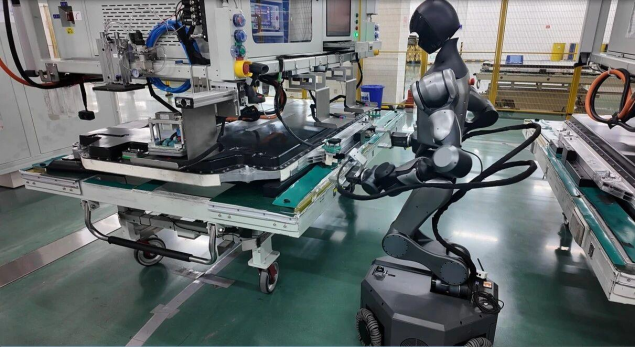
(Image courtesy of famous company’s official WeChat account)
Power Battery Management for Autonomous Vehicles
Real-time feedback: Current sensors are integrated with the BMS (Battery Management System) to adjust charging and discharging strategies in real time, ensuring battery safety under extreme operating conditions. Although the CHIPSENSE current sensor only plays a calibration role in the BMS, its function is very important.
Historical data analysis: Big data analysis of current curves is used to predict battery degradation trends and support predictive maintenance.
Technical Challenges
Of course, current sensors also have certain limitations, such as electromagnetic interference. Inverters, motors, and other equipment on the production line may generate interference, requiring shielded cables and digital filtering techniques to ensure data accuracy. Regarding temperature drift, in addition to selecting wide-temperature range sensors, regular calibration is also necessary.
Furthermore, current sensors need to seamlessly integrate with systems such as MES, ERP, and BMS to ensure real-time data sharing and rapid fault response.
For solid-state batteries, current sensors also need to support higher voltages (above 800V) and faster response times (<1ms) to accommodate the high power density characteristics of solid-state batteries. CHIPSENSE offers a wide range of current sensor options, including even customized solutions.
Conclusion
Current sensors play a dual role as both a "safety guardian" and a "data hub" in the intelligent manufacturing of new energy power batteries. Companies should select appropriate sensor technologies based on their actual needs and pay attention to their environmental adaptability, system integration capabilities, and intelligent upgrade directions. While pursuing high precision and high reliability, it is also important to recognize their limitations and build a comprehensive fault warning system through multi-sensor fusion and intelligent algorithms. With the development of technologies such as solid-state batteries and humanoid robots, the innovative applications of current sensors will continue to drive the high-quality development of the new energy power battery industry. CHIPSENSE current sensors will also undergo upgrades in line with technological advancements.
CHIPSENSE is a national high-tech enterprise that focuses on the research and development, production, and application of high-end current and voltage sensors, as well as forward research on sensor chips and cutting-edge sensor technologies. CHIPSENSE is committed to providing customers with independently developed sensors, as well as diversified customized products and solutions.
“CHIPSENSE, sensing a better world!
www.chipsense.net