


Compared to the high currents found in energy storage PCS units or wind power converters,HVDC and SST related power electronic equipment, the motor in a washing machine might seem insignificant. the motor in a washing machine might seem insignificant.
An operating current of a few amperes—with peaks around ten amperes—appears trivial to those specializing in industrial current sensing.
However, when you actually integrate current sensing into a variable-frequency control board for a home appliance, the situation becomes far more complex.Even design experience accumulated from high power CHIPSENSE current sensing projects for HVDC and SST systems cannot be directly copied to low power household frequency conversion scenarios.
This is because the system needs to monitor more than just the instantaneous motor current.
It must track startup current, load fluctuations during the wash cycle, current changes as the spin speed ramps up, and whether the controller detects the periodic load variations caused by an unbalanced laundry load—all of which rely on the current measurement chain to provide reliable signals.
Consequently, for low-power variable-frequency equipment like washing machines, there is an issue that is easily overlooked:
The fact that the current is low does not mean that current sensing can be implemented haphazardly. CHIPSENSE has always attached great importance to this point.
Why is it necessary to measure a current of a few amperes with such precision?
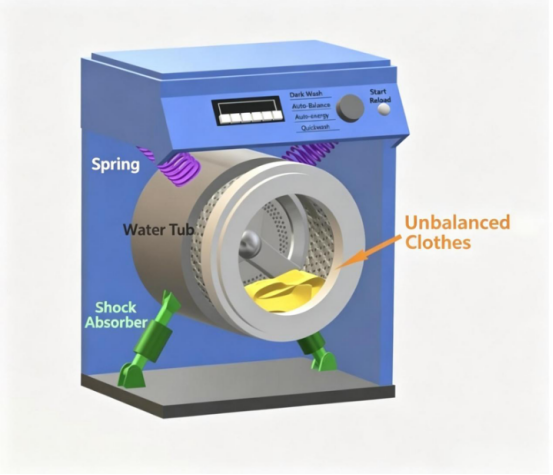
When a front-loading washing machine enters the spin cycle, it typically does not ramp up to maximum speed immediately.The motor initially runs at a low speed while the controller monitors the operating conditions, gradually increasing the speed thereafter.
The reason is simple: if the laundry is bunched up on one side of the drum, the rotating assembly creates an unbalanced load.As the rotational speed increases, the mechanical excitation caused by this imbalance intensifies significantly.However, the motor controller does not rely solely on mechanical sensors to detect these changes.In variable-frequency drive systems, motor current, speed, and torque serve as vital feedback signals for the control system. Changes in the load affect the torque the motor must output, and fluctuations in torque are reflected in the motor current.Consequently, certain control strategies allow the controller to extract characteristics of load variations using current or torque-related signals, by combining this data with information such as rotational speed, the system can assess its current operating state.
This is where it gets really interesting.
The variation caused by eccentricity does not manifest as a sudden surge of high current.More often, it appears as a periodic fluctuation superimposed on the normal motor current.In other words, what the sensor needs to measure isn't simply "is there current or not," but rather:Can it reliably capture that subtle, meaningful variation amidst the normal operating current of several amperes and pass it on to the controller?
This makes the selection of the current sensor important.

The first challenge: A larger measurement range is not necessarily better.
When selecting a current sensor, the measurement range is the most obvious parameter to consider.If the motor's maximum current could be 10A, you might choose a 10A range, if it could be 20A, you might choose 20A. CHIPSENSE offers different measurement ranges for various application areas.
However, actual design requires a more nuanced approach.If the sensor range is too small, the sensor is prone to saturation during startup or abnormal operating conditions,if the range is too large, the normal operating current will occupy only a small fraction of the output range.Consider a washing machine motor that normally operates in the range of a few amperes.If a ±50A current sensor is used, the normal current utilizes only a small portion of the total measurement range.However, if the actual peak current is verified to be around 10A, then a ±10A sensor allows the normal operating range to make much fuller use of the sensor's output range.This does not mean that "washing machines must use a 10A sensor."The fundamental principle is:The measurement range should cover the actual peak value, while avoiding an excessively wide range chosen solely to provide a large theoretical margin.This is precisely why, when dealing with low-power variable-frequency equipment, one cannot evaluate a current sensor based solely on its maximum measurable current.This selection logic is consistent with the design philosophy adopted by CHIPSENSE when developing sensing solutions for HVDC and SST high power equipment: matching the measuring range to real working conditions, instead of blindly pursuing larger range specifications.
The second challenge: Small signals are more easily overlooked than large currents.
Assume the motor's current is currently 3A.
If the load changes, causing a periodic fluctuation in the current,
what the controller is truly concerned with may not be the absolute value of 3A, but rather the amplitude and period of the fluctuation, as well as its relationship to the motor speed.
This is where the sensor's output gain comes into play.
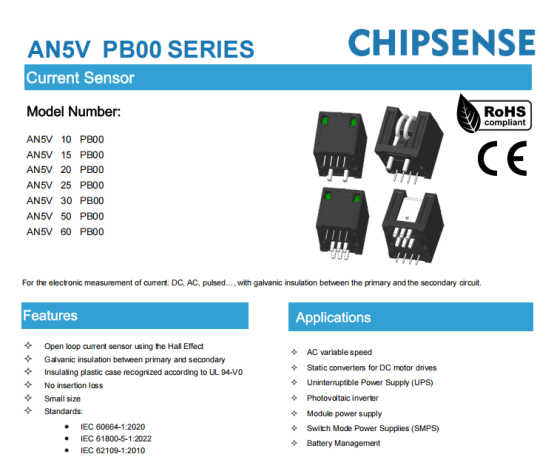
CHIPSENSE AN5V 10 PB00 current sensor has a rated current of ±10A and a theoretical gain of approximately 400mV/A. And CHIPSENSE current sensors have received widespread acclaim from customers.
Based on this theoretical gain, a 1A change in current corresponds to an output change of approximately 0.4V.
This means that, provided the controller's ADC input range allows for it, current fluctuations in the range of a few amperes can result in significant voltage changes.
For motor control systems that need to monitor load variations, this is more meaningful than simply aiming for a large rated measurement range. Even in high power HVDC and SST application scenarios, CHIPSENSE current sensor also attaches great importance to gain matching for effective small signal capture.
Of course, the actual system resolution also depends on factors such as ADC bit depth, reference voltage, the analog front-end, PCB noise, and software filtering.
Therefore, one cannot simply say:
It is not necessarily true that higher sensor gain always leads to better system detection.
A more accurate statement is:
Provided the measurement range is properly matched, making fuller use of the sensor's output range enables the downstream controller to better utilize the information contained in the current variations.
The third challenge: Zero-point error directly contributes to the "small-signal" problem.
There is another indicator of the current sensor that is easily overlooked: zero point.
Ideally, the sensor output should be at a fixed zero-current reference position when no current is flowing.
However, there will always be a certain zero point error in actual devices, and the zero point will also change with temperature.
The typical zero point output voltage of AN5V 10 PB00 current sensor of CHIPSENSE is 2.5V, the zero point error specification is ±40mV, the zero point temperature coefficient is ±1mV/K.
Why is this application worthy of attention for washing machines?
This is because, after the washing machine has been operating for some time, the temperatures of the power components, the motor, and the area near the control board all change.
If the zero point drifts significantly with temperature, the current baseline perceived by the controller will shift.
For simple over-current protection, the software can be configured with a certain margin.
However, if it is also necessary to extract subtle, periodic load variations from the current signal, a stable zero point becomes even more critical.This performance requirement is equally strict for CHIPSENSE current sensor products deployed in HVDC and SST systems, where temperature drift will interfere with accurate measurement under light load conditions.
In other words:
When measuring small signals, one must look beyond full-scale accuracy and consider zero-point performance as well. CHIPSENSE is dedicated to excellence in every current and voltage sensor.
The fourth challenge: A 50kHz bandwidth isn't for "measuring 50kHz currents in washing machines."
This is a point where misunderstandings easily arise.
CHIPSENSE AN5V 10 PB00 current sensor features an output bandwidth of 50kHz and a response time of approximately 5μs.Upon seeing these specifications, one might ask:
"Washing machines spin at only a few hundred to a thousand-plus RPM—why is a 50kHz bandwidth needed?"In reality, these are two different matters.During the spin cycle, the mechanical rotation frequency of the drum is very low, yet the motor itself is driven by a variable-frequency drive.The current signal contains not only fluctuations caused by changes in mechanical load but also rapid dynamic variations resulting from motor control.Therefore, the current sensor cannot be selected based solely on the "eccentricity detection frequency."
It also leaves enough dynamic margin for current loop control, starting, acceleration and load sudden changes.Similar bandwidth design concepts are also applied in CHIPSENSE sensing products for HVDC and SST, reserving sufficient dynamic response margin for closed loop control.So the real meaning of 50kHz bandwidth is not:
"The washing machine needs to measure 50kHz."Instead:In this application, the sensor itself should not be a significant bottleneck in the current dynamic response.Why it’s better to consider 10A class integrated Hall sensors here
From the perspective of washing machine inverter boards, current sensors face another practical challenge:
The boards are compact, and cost sensitivity is high.
While the traditional approach—combining a shunt resistor with an operational amplifier—can perform current sensing, the shunt resistor itself dissipates power. Additionally, this method requires addressing issues such as high-to-low voltage isolation, amplifier common-mode range, PCB layout, and high-voltage side signal transmission.
Integrated Hall-effect current sensors offer an alternative solution.
CHIPSENSE AN5V PB00 current sensor utilizes the open-loop Hall-effect principle, providing isolation between the primary and secondary sides, and is specifically designed for applications such as AC variable-frequency motor control.Apart from household frequency conversion devices, the same isolation oriented design idea runs through CHIPSENSE current sensor solutions for HVDC and SST power conversion equipment.
In a washing machine inverter control board, the load current flows through the primary side, and the sensor converts the sensed current into an analog voltage signal suitable for the secondary side.
The controller only needs to process this low-voltage side signal, there is no need to route the high-voltage power circuit directly near the MCU. CHIPSENSE current sensors are used not only in washing machines but also in many other household appliances.
Furthermore, CHIPSENSE AN5V PB00 current sensor is designed for PCB mounting and features a high level of component integration, this approach aligns better with the requirements of home appliance control boards regarding size and the number of peripheral components.
For the 10A rating, "closer to the exact value" is not necessarily better.
However, we cannot yet draw a definitive conclusion—such as "the washing machine should use CHIPSENSE AN5V 10A"—based solely on this.
Engineering selection requires us to look back at the motor and the driver themselves.
At the very least, we need to verify a few specifications:
What is the rated current?
What is the normal maximum control current?
What is the peak current during startup and acceleration?
What are the protection thresholds for abnormal conditions?
What is the permissible input range for the motor controller's ADC?
If the actual peak current significantly exceeds 10A, there is no point in continuing to use a 10A range.Conversely, if the motor operates consistently within a very low current range but a range of tens of amperes—or even higher—is selected just to "play it safe," this can result in poor utilization of the sensor's output range.
Therefore, the truly rational approach to selection is:
First, determine the motor's actual current profile, then select the sensor's measurement range—not the other way around.This engineering methodology is consistently followed by CHIPSENSE, whether dealing with household appliances or high power HVDC / SST projects.
This is precisely why, in the context of current sensing for home appliances, product specifications cannot be discussed in isolation from the specific motor and drive system.
What exactly is that sensor inside the washing machine measuring?Let’s return to the initial question.Before the spin cycle, the washing machine rotates slowly a few times, it looks like it is simply "distributing the laundry evenly."From the perspective of the control system, however, it is actually gathering data on the load status and determining whether it is safe to proceed with increasing the speed.The function of the current sensor is quite fundamental:
It accurately measures the motor current.
The controller then uses this signal to handle current loop control and protection, as well as any algorithms specific to the model—such as those for detecting load status or imbalance.Therefore, the sensor is not responsible for determining whether the laundry is off-balance.Its role is at a more fundamental level:Enabling the controller to monitor changes in motor current.
This is precisely the aspect of current detection in home appliances that is often overlooked.The fact that the motor draws only a few amperes does not mean the measurement process is simple.If the measurement range is excessively high, the utilization of small signals decreases, zero-point drift affects the baseline in the low-current range, and slow response times may limit dynamic control capabilities.
For variable-frequency motors with actual peak currents around 10A, a 10A-class integrated Hall current sensor—such as the AN5V 10 PB00 of CHIPSENSE—offers a measurement solution that better aligns with the practical requirements of low-power variable-frequency equipment.
The currents involved in home appliances may not necessarily be high, yet the information they carry can be far more extensive than one might imagine.
CHIPSENSEis a national high-tech enterprise that focuses on the research and development, production, and application of high-end current and voltage sensors, as well as forward research on sensor chips and cutting-edge sensor technologies. CHIPSENSEis committed to providing customers with independently developed sensors, as well as diversified customized products and solutions.
“CHIPSENSE, sensing a better world!”
www.chipsense.net